

Before a non-EU hire can get a work visa for Germany, their degree usually needs to be verified as equivalent to a German qualification. The two systems — anabin (free, instant) and ZAB (paid, 4–8 weeks) — serve different purposes. Here's how they work, when you need which, and how to avoid the delays that catch most employers off guard.
Why degree recognition is needed
German immigration law requires proof that a foreign qualification is comparable to a German one. This applies to:
- EU Blue Card: Degree must be recognised or rated "H+" in anabin
- §18b Skilled Worker (academic): Degree must be comparable to a German Hochschulabschluss
- Regulated professions: Full professional recognition required (separate process)
For non-regulated professions (most tech, business, and creative roles), you need degree equivalence for the visa — not professional recognition. This is simpler and faster.
The anabin database
anabin (anabin.kmk.org) is a free, publicly accessible database maintained by the KMK (Standing Conference of Education Ministers). It contains pre-evaluated ratings for thousands of foreign universities and degree programmes.
| Rating | Meaning | Action needed |
|---|---|---|
| H+ | Comparable to a German degree | None — accepted for Blue Card and work visa |
| H+/− | Partially comparable / conditional | May need ZAB certificate for confirmation |
| H− | Not comparable | ZAB evaluation required — may not qualify for Blue Card |
| Not listed | University or programme not in database | ZAB individual evaluation required |
Tip
Check anabin before extending the offer. If the university is rated H+ and the programme is listed, you can skip the ZAB process entirely — saving 4–8 weeks.
The ZAB certificate
The Zentralstelle für ausländisches Bildungswesen (ZAB) issues individual degree evaluations when anabin doesn't have a clear rating. It's the gold standard — every Ausländerbehörde and embassy accepts a ZAB certificate without question.
Step-by-step process
Check anabin first
Search for the university and degree programme. If rated H+, you're done — print the result and include it in the visa application.
If not in anabin or rated H+/−: apply for ZAB
Submit the online application with degree certificate, transcript, and certified translations.
ZAB evaluates the degree
They compare it to the German education system and issue a Zeugnisbewertung (credential evaluation).
Receive the certificate
Digital PDF delivered to your email. Include it in the visa/Blue Card application package.
Submit with visa application
The embassy or Ausländerbehörde uses the ZAB certificate (or anabin H+ result) to verify qualification requirements.
Timelines and costs
| Method | Cost | Time | When to use |
|---|---|---|---|
| anabin check | Free | Instant | Always check first |
| ZAB standard | €200 | 4–8 weeks | When anabin is unclear or not listed |
| Certified translation | €100–300 | 3–7 days | If documents are not in English or German |
Common issues and how to avoid them
University not in anabin
→ Apply for ZAB immediately. This is the #1 cause of delays — start it before the contract is signed.
3-year bachelor's degree rated as 'not comparable'
→ Some countries (India, Philippines) issue 3-year bachelor's degrees that don't match Germany's 4-year standard. A ZAB evaluation can sometimes resolve this by considering additional qualifications.
Documents not in English or German
→ Get certified (sworn) translations before applying to ZAB. Uncertified translations are rejected.
Diploma mill or unaccredited institution
→ If the university is not government-accredited in the home country, the degree will not be recognised in Germany. Check accreditation status before hiring.
Tips for HR teams
Check anabin during the interview process
Don't wait until the offer is signed. A 5-minute anabin check can save 8 weeks.
Start ZAB in parallel with contract negotiations
If ZAB is needed, begin the application while finalising the offer. The candidate can apply themselves.
Keep a ZAB certificate library
If you hire multiple people from the same university, one ZAB evaluation covers the institution — not just the individual.
Use a relocation partner for degree recognition
relokate checks anabin, initiates ZAB when needed, and coordinates translations — so your HR team doesn't have to navigate the process.
Summary
- Always check anabin first — it's free and instant
- H+ rating = no further action needed for the visa
- ZAB takes 4–8 weeks and costs €200 — start early
- Degree recognition ≠ professional recognition — for regulated professions, a separate process applies
- Biggest time saver: check anabin during interviews, not after the offer
For HR teams
Want to see how relokate handles this?
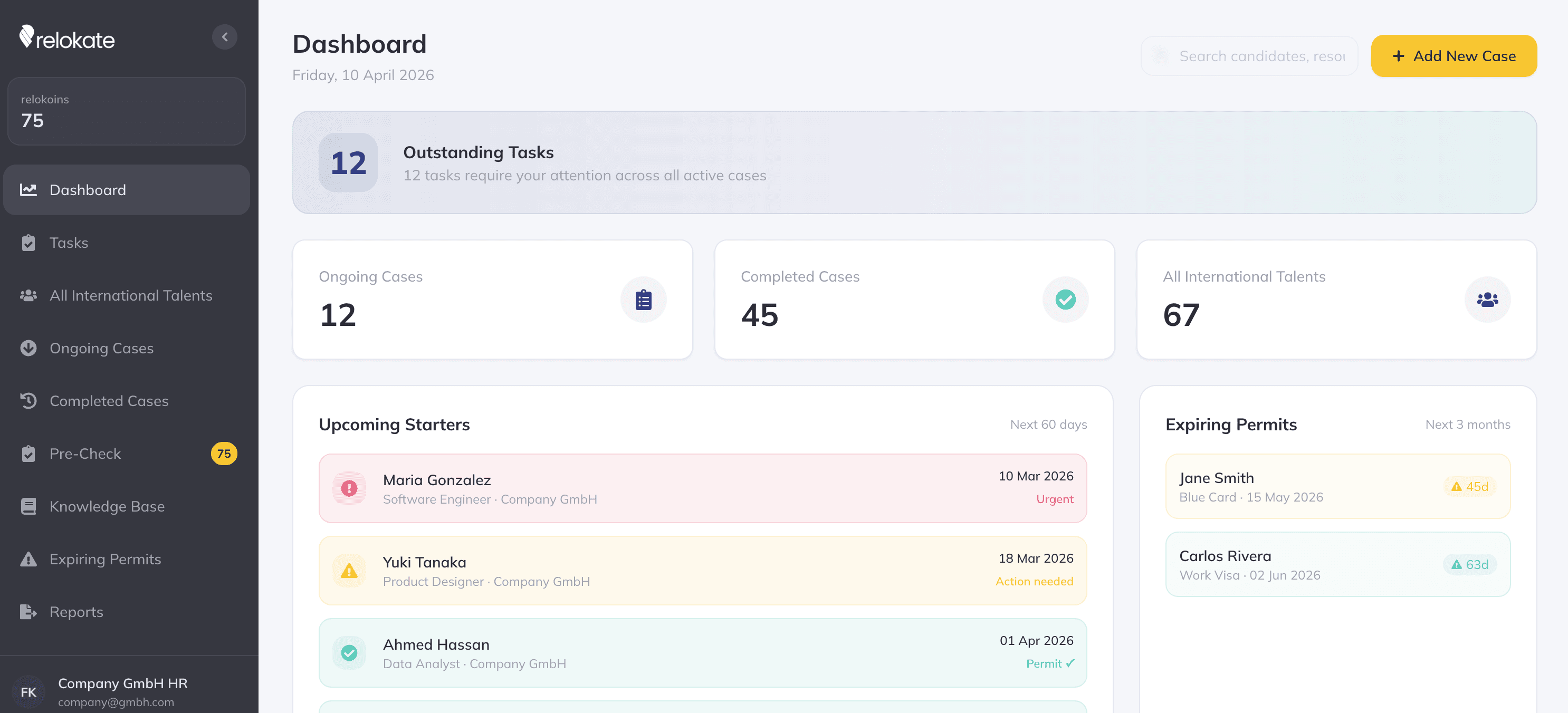
Track every case in real time — visa status, tasks, documents, and deadlines in one dashboard. Book a 15-minute call and we'll walk you through it.
Book a call →About the author

Hanna Kovacs
Product Manager, Global Mobility
Professional experience across the US, Hungary, and Germany in product management and operations. Deep expertise in German immigration law and the regulatory landscape for skilled worker migration. At relokate, Hanna owns the product roadmap, drives platform automation, and develops the compliance frameworks and immigration content that HR teams rely on.
Related glossary terms
Keep reading
Immigration & Visas
Regulated Professions Germany 2026: How to Check
Regulated vs non-regulated professions in Germany. Is logistics manager, engineer, or architect regulated? How to che...
Immigration & Visas
EU Blue Card Germany 2026: €50,700 Salary Threshold Explained
Does your hire qualify? €50,700 general / €45,934 shortage roles in 2026. IT without degree (3+ yrs exp). §81a fast-t...


