

There are dozens of immigration service providers in Germany — from solo immigration lawyers to global platforms to boutique relocation agencies. Choosing the wrong one costs you time, money, and frustrated hires. This guide gives you a practical framework for evaluating providers and making the right choice for your company.
One legal point first: in Germany, legal advice on an individual case is a legal service that only lawyers and a few other authorised persons may provide (§§2, 3 of the Legal Services Act, RDG). Other providers may give legal services only as a minor part of their main service (§5 RDG). Ask every non-law-firm provider who takes over when a case needs a legal assessment or legal action — at relokate, which is not a law firm, that is an independent partner attorney engaged and paid by the client.
The four types of immigration service providers
Immigration lawyers
Pros: May give legal advice on the individual case and represent you in court
Cons: Fees agreed individually; case-tracking software and relocation services vary by firm
Best for: Complex legal questions, refusals, appeals, court cases
Traditional relocation agencies
Pros: Full-service including housing, schools, settling-in
Cons: Case-status visibility varies; individual legal advice on immigration must come from lawyers
Best for: Executive relocations with large budgets
Global mobility platforms
Pros: Software dashboard, multi-country coverage, HRIS integrations
Cons: Depth of Germany-specific practice varies by provider; check what the subscription includes
Best for: Companies with relocations across 5+ countries
Hybrid platforms (software + service)
Pros: Software-led process with specialists who prepare the cases
Cons: Typically country-specific (not global); legal action through partner attorneys
Best for: Companies primarily hiring to one country (e.g., Germany)
8 questions to ask every provider
1. Do you specialize in German immigration?
Germany's immigration system has its own complexities (Ausländerbehörde processes, qualification recognition, rules and practice that differ by federal state and city). Ask for examples of cases like yours.
2. What's your pricing model?
Per case? Monthly or annual subscription? Retainer? Which fees (government fees, translations, legal fees) sit outside the quote? You should know the full cost before you commit.
3. Do you have immigration attorney backup?
When a case gets rejected or delayed, you need legal escalation — not just a helpdesk ticket. Ask who takes legal action, who engages the attorney, and who pays for it.
4. Can I track cases in real time?
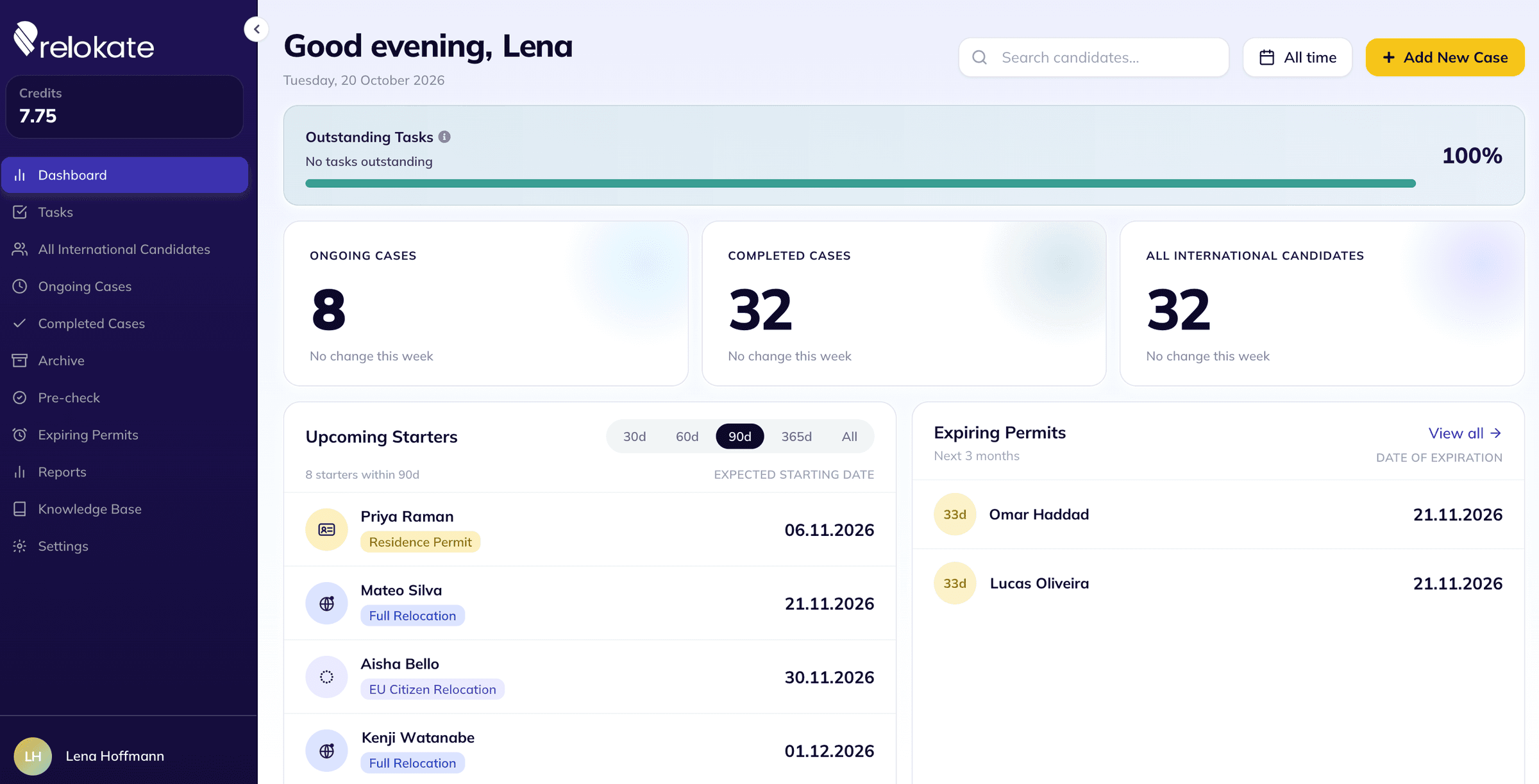
If your provider communicates only via email, you'll spend hours asking for updates. A real-time dashboard shows the case status without asking.
5. Who is my point of contact?
A dedicated case partner who knows your hire by name is fundamentally different from a rotating support team. Ask how many cases each person handles.
6. What's included beyond the visa?
The visa is only half the process. Anmeldung, health insurance, bank account, housing — does the provider handle these, or are they extra?
7. How do you handle delays?
Immigration offices can be slow to respond. Ask specifically: what happens when the Ausländerbehörde doesn't respond for 3 months — the point from which an action for failure to act is generally admissible (§75 VwGO)?
8. Can you show me references?
Ask for client references in your industry and company size. Check Google reviews and G2 ratings for unfiltered feedback.
Red flags to watch for
- No pricing transparency: If a provider won't discuss pricing ranges before a demo, expect surprises later
- No Germany-specific experience: A team without hands-on experience with German immigration offices can miss local practice
- Email-only communication: No dashboard = no visibility. Your HR team will have to request status updates manually
- No legal escalation path: "We'll follow up with the authority" is not the same as having an attorney ready to bring an action for failure to act under §75 VwGO
- Unclear commitments: Check whether an annual contract includes minimum case volumes or fees, and what you pay in a year with few hires
Provider comparison framework
| Criteria | Immigration Lawyer | Global Platform | Hybrid (e.g., relokate) |
|---|---|---|---|
| Pricing | Fees agreed individually | Varies (subscription + fees) | Per case + annual software fee (relokate: cases from €950) |
| Real-time dashboard | No | Yes | Yes |
| Legal escalation | Yes (the lawyer acts directly) | Varies (often external referral) | Hand-off to independent partner attorneys, engaged and paid by the client |
| Germany depth | Depends on the firm | Varies by provider | Focus on Germany; trusted partners for other countries |
| Settlement services | No | Limited | Yes (full) |
| Dedicated partner | Yes (the lawyer) | Varies | Yes |
| Scalable for 10+ hires | Depends on firm size | Yes | Yes |
Evaluating providers for Germany?
See how relokate compares. Book a 30-minute demo — no commitment, just an honest walkthrough.
Book a demoFrequently asked questions
What types of immigration service providers are available in Germany?
The four main types are: (1) immigration lawyers — the only providers, apart from a few other authorised persons, who may give legal advice on an individual case and represent you in court (§3 RDG); fees are agreed individually; (2) relocation agencies — logistics-focused; they may not give individual legal advice on immigration; (3) global HR and immigration platforms (e.g. Boundless, Deel) — one provider for many countries; (4) Germany-specialist providers like relokate — digital case management with specialists who prepare the cases, and escalation to independent partner attorneys when legal action is needed.
What questions should I ask an immigration service provider before hiring them?
Key questions: Who gives legal advice and takes legal action — lawyers on staff or independent partner attorneys, and who engages and pays them? Which processing times do you see for an EU Blue Card at our immigration office, and what are they based on? How do you handle Ausländerbehörde rejections or delays? What is your pricing model — per case, subscription or retainer, and what sits outside the quote? Do you cover family reunification? What compliance workflows do you have for §45c AufenthG?
What are the red flags when evaluating a German immigration service?
Red flags include: vague timelines without data to back them up, no mention of attorneys or legal oversight, a non-law-firm provider that offers individual legal advice, inability to explain the Beschleunigtes Fachkräfteverfahren process, unclear pricing, no clear escalation path for rejected cases, and no experience with the federal state where your employees will be registered.
Should I use a global HR platform or a Germany-specialist for hiring to Germany?
If Germany accounts for the majority of your international hiring, a Germany specialist is usually the better fit, because procedures and practice differ between immigration offices and federal states. Global platforms make more sense when you hire across 5+ countries and need consistency of tooling over depth in any single market.
What is the difference between a relocation agency and an immigration service?
A relocation agency manages practical logistics: housing search, school placements, move coordination, and settling-in support. An immigration service handles the permit side: permit applications, document preparation, Ausländerbehörde submissions, and compliance; legal advice on an individual case and legal action come from lawyers. For international hires to Germany, you usually need both, so check which parts each provider covers.
How does relokate help with immigration and relocation to Germany?
relokate combines HR software with immigration specialists who take over every step: visa and residence permit cases at any of Germany's more than 500 immigration offices (in Berlin registered with the Business Immigration Service), family reunification, and follow-ups with authorities, including formal follow-up letters (Untätigkeitsschreiben). HR follows each case in the relokate dashboard. relokate is not a law firm: when legal action is needed, an independent partner attorney engaged and paid by the client takes over; more than 95% of relokate cases need no attorney escalation. Cases start from €950 plus an annual software & compliance subscription. Next step: book a 30-minute demo.
Ready to streamline your relocations?
See how relokate compares — book a demo and get a custom pricing estimate for your team.
About the author

Katharina Hilgers
Founder & Managing Director, relokate
Over a decade of experience in HR, People Operations, and global mobility. Founded relokate in 2020 after seeing firsthand how complex and fragmented the relocation process was for companies hiring internationally. Previously led international hiring at high-growth companies, managing relocations across 30+ nationalities. Today, Katharina combines strategic HR expertise with technology to make global hiring to Germany simple, compliant, and human.


