

Many IT positions in Germany stay unfilled — and the local talent pool cannot close the gap. International hiring is no longer optional for tech companies in Germany; it's a competitive necessity. The good news: recent immigration reforms have made it significantly easier to bring IT specialists to Germany. Here's the complete guide to visa options, salary thresholds, and relocation essentials for 2026.
Why hire IT talent from abroad?
- Talent scarcity: Germany's domestic IT talent pool cannot meet demand, especially for senior roles in AI, cloud, cybersecurity, and backend engineering
- Diverse perspectives: International hires bring different problem-solving approaches and global market understanding
- Higher retention: Employees who relocate for a role tend to stay longer — the commitment of moving countries creates natural loyalty
- Regulatory support: The Fachkräfteeinwanderungsgesetz (Skilled Worker Immigration Act) was reformed specifically to make international IT hiring easier
Essential visa options for IT specialists
EU Blue Card (recommended for most IT hires)
The Blue Card is the fastest path for most IT professionals. IT is classified as a shortage occupation, so the lower salary threshold applies once the Federal Employment Agency approves. Experienced IT professionals without a university degree can qualify with at least 3 years of relevant experience gained within the last 7 years.
Skilled Worker Visa (§18a/18b AufenthG)
Fast-Track Procedure (§81a AufenthG)
The accelerated skilled worker procedure sets legal deadlines for single steps but no total duration. In relokate's cases the immigration office's pre-approval is the bottleneck, and the regular route with a Federal Employment Agency pre-approval can sometimes be faster. It costs EUR 411 and requires the employer to initiate the process with the competent immigration office (a central office in many states). relokate handles this process end-to-end for eligible cases.
Relocation essentials for IT hires
Housing
Temporary housing for the first 3 months is critical in tight markets like Berlin and Munich. Plan for EUR 1,200-2,000/month.
Anmeldung
Mandatory city registration within two weeks of moving in (§17 BMG). Required for the tax ID and often for a bank account.
Health insurance
Must be activated before the work start date. Public insurance is standard; private insurance is an option only above the compulsory-insurance threshold (EUR 77,400 a year in 2026).
Bank account
German IBAN needed for salary payments. Some banks require Anmeldung first; digital banks like N26 can bridge the gap.
Common mistakes to avoid
- Salary miscalculations: Only the fixed salary and contractual, unconditional special payments (such as Christmas or holiday pay) count toward the Blue Card threshold; performance bonuses don't
- Job-title mismatches: The job description must align with the candidate's qualification. "Senior Developer" with a marketing degree raises red flags
- Late document preparation: Start collecting certified documents, translations and the degree check before the contract is signed; an apostille or legalisation is needed only where the candidate's country requires it
- Ignoring processing times: Embassy waits differ widely by country and there is no deadline for the whole procedure. Agree a realistic start date with hiring managers early
What sets the timeline: offer to first workday
There is no legal deadline for the whole process. The law sets deadlines for single steps; how long the rest takes depends on the candidate's country, the embassy and the immigration office. In relokate's cases the longest wait is usually the embassy appointment or, in the fast-track procedure, the immigration office's pre-approval.
| Step | What the rules say | What decides the pace |
|---|---|---|
| Degree check | A degree listed in anabin (institution H+, degree “entspricht”) needs no further check; otherwise a ZAB statement of comparability, which takes about three months | Whether the degree is already listed. IT specialists without a degree use the experience route instead (§18g(2) AufenthG) |
| Federal Employment Agency approval | Deemed granted if the agency doesn’t respond within two weeks, one week in the fast-track procedure (§36(2) BeschV) | A complete job description with salary and working hours |
| Embassy | In the fast-track procedure: appointment within three weeks, decision usually within another three (§31a AufenthV). Without fast-track there is no deadline | Appointment availability at the mission, which differs widely by country |
| Entry and registration | Register the new address within two weeks of moving in (§17 BMG) | Finding a flat and getting the residence-permit appointment at the local office |
Hiring IT talent to Germany?
relokate handles the entire visa and relocation process — so your team can focus on the technical interview, not the paperwork.
Book a demoFrequently asked questions
Can IT specialists get an EU Blue Card in Germany without a university degree?
Yes. Since 18 November 2023, IT specialists with at least three years of comparable professional experience gained within the last seven years can get an EU Blue Card without a university degree (§18g(2) AufenthG). They must reach the reduced salary threshold of EUR 45,934.20 gross per year in 2026, and the Federal Employment Agency has to approve.
What is the EU Blue Card salary threshold for IT roles in Germany in 2026?
IT roles fall under the shortage occupation category, so the reduced EU Blue Card threshold applies: EUR 45,934.20 gross per year (2026), with approval by the Federal Employment Agency. This is lower than the general threshold of EUR 50,700. The IT shortage occupation list includes software developers, data scientists, system administrators, and related roles.
How long does it take to hire an IT specialist from abroad to Germany?
There is no legal deadline for the whole process. In the fast-track procedure (Beschleunigtes Fachkräfteverfahren, §81a AufenthG), the Federal Employment Agency's approval is deemed granted after one week (§36(2) BeschV), and the embassy offers a visa appointment within three weeks and usually decides within another three (§31a AufenthV); the immigration office's pre-approval before that has no fixed deadline. Without fast-track, there are no deadlines for the embassy. Candidates already in Germany on a Chancenkarte may work up to 20 hours a week and do trial work of up to two weeks each (§20a(2) AufenthG) before switching to a Blue Card or skilled-worker permit.
What is the best visa for hiring a software developer from India or Brazil to Germany?
The EU Blue Card is the best option for most developers from India or Brazil, provided the salary meets EUR 45,934.20 (2026, with Federal Employment Agency approval). It offers the fastest path to permanent residence (27 months with A1 German, 21 months with B1), immediate full work rights for the spouse, and a straightforward process for the employer. For developers without a degree, the Blue Card remains available with at least three years of IT experience within the last seven years.
Do IT workers from abroad need their qualifications recognised in Germany?
IT jobs (software development, data science, DevOps, etc.) are not regulated professions, so no licence to practise is needed. For the visa, however, a foreign degree must be recognised or comparable to a German one: listed in anabin (institution H+ and the degree rated equivalent) or confirmed by a ZAB statement of comparability. IT specialists without a degree can instead use the experience route of the Blue Card (§18g(2) AufenthG).
How does relokate help with hiring IT talent from abroad?
relokate takes over the entire visa and relocation process for your IT hires: relokate checks the Blue Card salary threshold and either the degree or the three-year experience route, prepares the Federal Employment Agency paperwork, chooses with you between the regular route and the fast-track procedure, coordinates the embassy appointment and handles the Blue Card at any of Germany's more than 500 immigration offices, following up with authorities directly. In relokate's cases a Blue Card takes 8–16 weeks for the whole process. Anmeldung, health insurance and a bank account can be added to the case. Next step: book a 30-minute demo.
For HR teams
Want to see how relokate handles this?
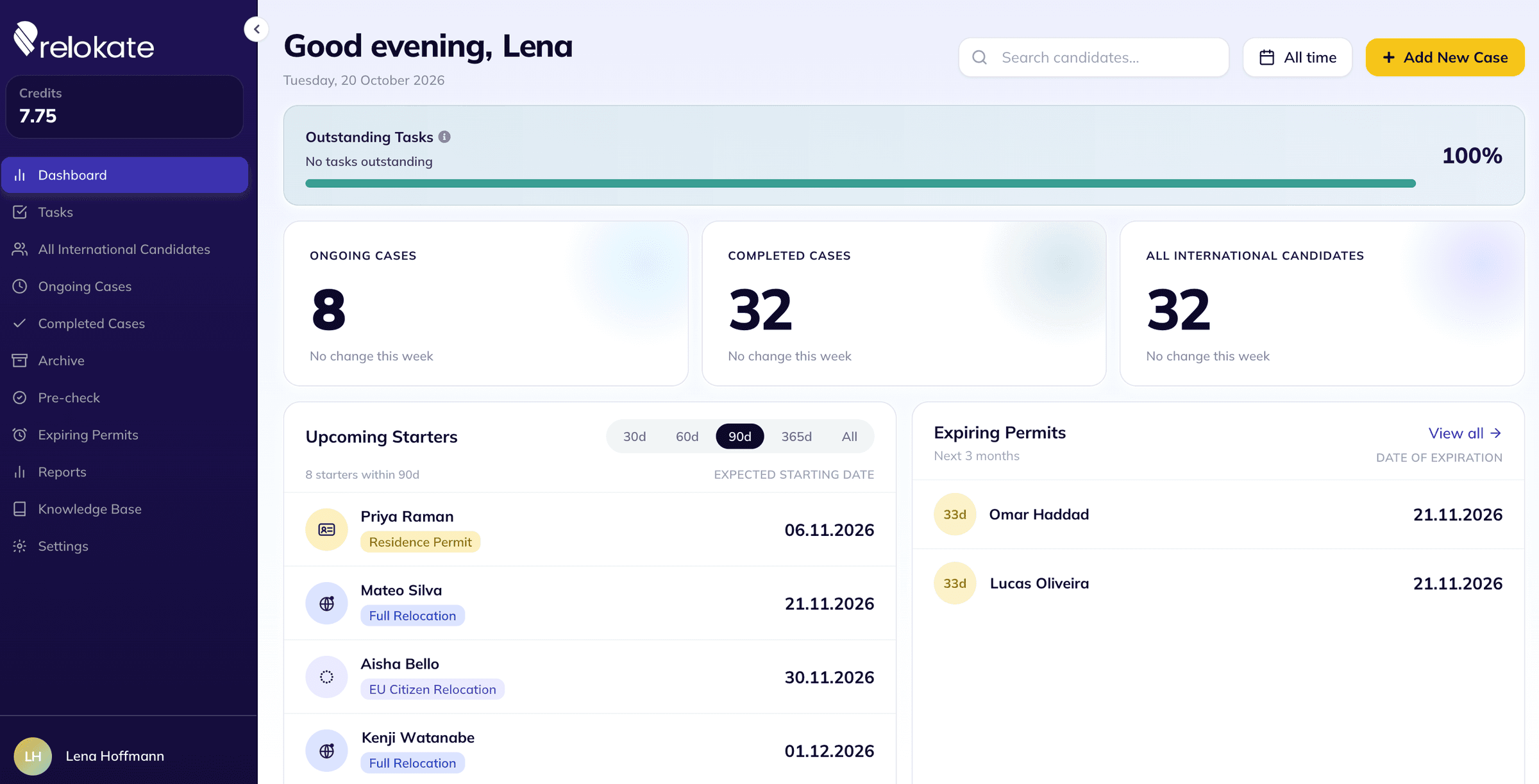
Track every case in real time — visa status, tasks, documents, and deadlines in one dashboard. Book a 30-minute demo and we'll walk you through it.
Book a call →About the author

Hanna Kovacs
Product Manager, Global Mobility
Professional experience across the US, Hungary, and Germany in product management and operations. Deep expertise in German immigration law and the regulatory landscape for skilled worker migration. At relokate, Hanna owns the product roadmap, drives platform automation, and develops the compliance frameworks and immigration content that HR teams rely on.
Related guides
Keep reading
Immigration & Visas
EU Blue Card Germany 2026: €50,700 Salary Threshold Explained
Does your hire qualify? €50,700 general / €45,934.20 shortage roles in 2026. IT without a degree (3+ yrs experience)....
Immigration & Visas
Work Permit Germany 2026: Employer Guide
Every work permit route to Germany explained — Blue Card, skilled worker visa, ICT card, and more. Which one fits you...


