

Germany has 5+ distinct work permit routes for non-EU employees — and choosing the right one can save weeks of processing time and thousands of euros. This guide compares every option side by side, with processing times and requirements, so you can match the right permit to each hire.
All permit types at a glance
| Permit | Best for | Degree needed? | Min. salary | Time to PR |
|---|---|---|---|---|
| EU Blue Card | University-educated professionals | Yes* | €50,700 / €45,934.20 | 21–27 months |
| §18a Skilled Worker (Vocational) | Tradespeople, technicians | Vocational cert. | None (45+ at first permit: €55,770 or pension proof) | 3 years (2 after German training/study) |
| §18b Skilled Worker (Academic) | Degree holders below Blue Card salary | Yes | None (45+ at first permit: €55,770 or pension proof) | 3 years (2 after German training/study) |
| ICT Card | Intra-company transfers | Varies | None | N/A (temporary) |
| Chancenkarte | Job seekers (no offer yet) | Not always | None | Must switch first |
| §19c(2) Experience-based (§6 BeschV) | Experienced workers without German recognition | Home-country qualification (2+ years' training) or degree; not required in IT | €45,630 unless collective agreement (45+: €55,770) | 5 years (§9) |
| §19c(1) Specialist route (§3 No. 3 BeschV) | Specialists with special, company-specific knowledge whose qualification is not recognised | No recognition needed; qualified job | No fixed threshold; pay as for comparable German staff (BA check) | 5 years (§9) |
*IT professionals with at least three years' experience in the last seven years can get a Blue Card without a degree (§18g(2) AufenthG, with Federal Employment Agency approval). Salary figures are for 2026.
EU Blue Card
The EU Blue Card is the gold standard for hiring qualified non-EU talent. It offers the fastest path to permanent residence and the most rights (family reunification without language requirements, spouse work rights from day one).
Use when: Your hire has a university degree (or at least 3 years' IT experience in the last 7 years) and the salary meets the €50,700 / €45,934.20 threshold. This should be your default choice for professional roles.
Skilled Worker Visa (§18a/18b)
The §18a (vocational) and §18b (academic) skilled worker visas cover cases where the Blue Card doesn't apply:
- §18a: For workers with recognised vocational training (Berufsausbildung) — electricians, nurses, mechatronics technicians, etc. No general salary minimum, but applicants aged 45 or over at their first permit need €55,770 (2026) or proof of adequate pension provision.
- §18b: For degree holders whose salary falls below the Blue Card threshold. Settlement permit after 3 years (2 after German training or study, §18c(1)) vs. 21–27 months with the Blue Card. The 45+ rule above applies here too.
- Key requirement: A vocational qualification needs an equivalence decision from the competent body (e.g. IHK FOSA or the Handwerkskammer); a degree must be recognised or comparable (anabin or a ZAB statement of comparability). The recognition body decides within three months of receiving complete documents (§6(3) BQFG).
- Federal Employment Agency (BA) approval: Usually required for §18a and §18b. The BA checks that pay and working conditions are comparable to those of domestic employees. There is no priority check (labour-market test) for skilled workers (§39(2) AufenthG).
Use when: Your hire is a skilled tradesperson (§18a) or a degree holder whose salary doesn't reach the Blue Card threshold (§18b).
ICT Card
The Intra-Corporate Transfer (ICT) Card is for multinationals transferring employees from a non-EU office to their German entity:
- The employee must have worked for the company or group for at least 6 months immediately before the transfer (trainees included, §19(2) AufenthG)
- Valid for up to 3 years (1 year for trainees)
- The employee remains on their home country contract — no German employment contract needed
- Designed as a temporary assignment, not as a route to permanent residence
Use when: You're transferring a manager, specialist, or trainee from your non-EU office for a temporary assignment.
Chancenkarte
The Chancenkarte isn't a work permit — it's a job-seeking permit. But it's relevant for employers because it creates a pool of pre-qualified candidates already in Germany who can switch to a residence permit for work.
Use when: You find a candidate who is already in Germany on a Chancenkarte. Hire them and transition to a Blue Card or §18a/18b.
Side-by-side comparison
| Blue Card | §18a | §18b | ICT | |
|---|---|---|---|---|
| Processing time in relokate's cases (excl. recognition) | 8–16 weeks | Depends on the embassy | Depends on the embassy | Depends on the embassy |
| Spouse work rights | May work (no separate permit) | May work (no separate permit) | May work (no separate permit) | May work (no separate permit) |
| Spouse language req. | None | None (since March 2024) | None (since March 2024) | None |
| Job change allowed? | First 12 months: notify ABH (§82), which may suspend the change for 30 days (§18g(4)); then free | With approval | With approval | No (tied) |
| BA approval needed? | No at the standard threshold; yes at the reduced threshold and on the IT route | Yes | Sometimes | Yes (§10a BeschV) |
Which permit fits your hire?
Software developer with CS degree, €55K salary
→ EU Blue Card (shortage occupation threshold met)
Senior developer, no degree, 6 years experience, €50K salary
→ EU Blue Card (IT experience path, §19c(2) as backup)
Electrician from Serbia with vocational certificate
→ Western Balkans Regulation (quota-limited) or §18a
Marketing manager with MBA, €42K salary
→ §18b (below Blue Card threshold, degree recognised)
Company transfers a project lead from US office for 2 years
→ ICT Card (intra-company transfer, no German contract)
Talented candidate, no offer yet, wants to search in Germany
→ Chancenkarte (6+ points, then switch to Blue Card/§18a when hired)
Processing times
In relokate's cases, an EU Blue Card takes 8–16 weeks for the whole process, plus any recognition step. The main bottlenecks:
- Embassy appointment wait: varies dramatically by country and embassy
- Visa processing: depends on the embassy; in the fast-track procedure it usually decides within three weeks of the appointment (§31a AufenthV)
- Qualification recognition (if needed): a ZAB statement usually takes about 3 months; recognition bodies decide within 3 months of complete documents (§6(3) BQFG). Start this first!
- Ausländerbehörde in Germany: depends on the office's appointment availability, which varies a lot between cities
Step-by-step for employers
Identify the right permit
Match the candidate's profile to the permit type using the comparison table above.
Start degree/qualification recognition
If needed, check anabin or start the ZAB or equivalence procedure immediately. It is often the longest step.
Prepare employer documents
Employment contract (or binding job offer), the 'Erklärung zum Beschäftigungsverhältnis' form, company registration (Handelsregister) and a job description.
Candidate applies at embassy
Support them with document prep and appointment booking. Provide a company support letter.
Arrange arrival logistics
Temporary housing, Anmeldung, bank account, health insurance. The employee can start working on the D-visa.
Ausländerbehörde appointment
Book early. Apply for the residence permit (Blue Card, §18a, etc.) within the D-visa validity period.
Not sure which route to take?
Use relokate's free Visa Eligibility Check to get a personalised recommendation based on your candidate's profile — nationality, degree, experience, and salary. Takes 2 minutes.
Frequently asked questions
What work permit options are available for hiring international talent to Germany?
The main routes are: EU Blue Card (degree + salary threshold), the §18a/§18b skilled worker visa (vocational or academic qualification), the ICT Card for intra-company transfers, the Chancenkarte job-search visa, and the Western Balkans Regulation for workers from 6 Balkan countries. The right route depends on qualifications, salary, and nationality.
Which German work permit is best for hiring a software engineer?
For most software engineers, the EU Blue Card is the best option if the salary meets the threshold (EUR 45,934.20 for IT and other shortage occupations in 2026, with Federal Employment Agency approval). IT specialists with at least three years of professional experience in the last seven years can qualify without a university degree. The Blue Card also gives faster access to permanent residence and brings the spouse's immediate full work rights.
What is the ICT Card and who can use it?
The ICT (Intra-Corporate Transfer) Card is for employees of multinational companies being transferred to a German entity for more than 90 days. The employee must have worked for the company or group for at least 6 months immediately before the transfer (trainees included) and be a manager, specialist, or trainee. It does not require a new employment contract for Germany.
How long does a German work permit take to process in 2026?
In relokate's cases, an EU Blue Card takes 8–16 weeks for the whole process, plus any recognition step; other permits depend mainly on the embassy. With the fast-track procedure (Beschleunigtes Fachkräfteverfahren, §81a AufenthG), the law sets deadlines for single steps: the Federal Employment Agency (BA) decides within 1 week, and the embassy offers a visa appointment within 3 weeks and usually decides within another 3; the local Ausländerbehörde's review before that has no fixed deadline and depends on the city.
Does an employer need to do anything before the employee applies for a German work visa?
Yes. For most visa types, the employer provides a signed employment contract (or binding job offer) and the 'Erklärung zum Beschäftigungsverhältnis' form, and may initiate the fast-track procedure at the Ausländerbehörde. Where the Bundesagentur für Arbeit must approve, it checks pay and working conditions; there is no priority check (labour-market test) for skilled workers under §18a/§18b or the Blue Card. For regulated professions, the licence to practise must be granted or promised first — or, under the recognition partnership, the recognition procedure formally agreed.
How does relokate help with work permits for international hires?
relokate takes over every step of a German work permit as a full-service visa and relocation partner: relokate matches each hire to the right route (EU Blue Card, §18a/§18b, ICT Card, §19c or Western Balkans Regulation), prepares the employer documents and the Erklärung zum Beschäftigungsverhältnis, coordinates the embassy appointment and handles the residence permit at any of Germany's more than 500 immigration offices, following up with authorities directly. In relokate's cases a Blue Card takes 8–16 weeks for the whole process. HR follows every case in the relokate dashboard. Next step: book a 30-minute demo.
For HR teams
Want to see how relokate handles this?
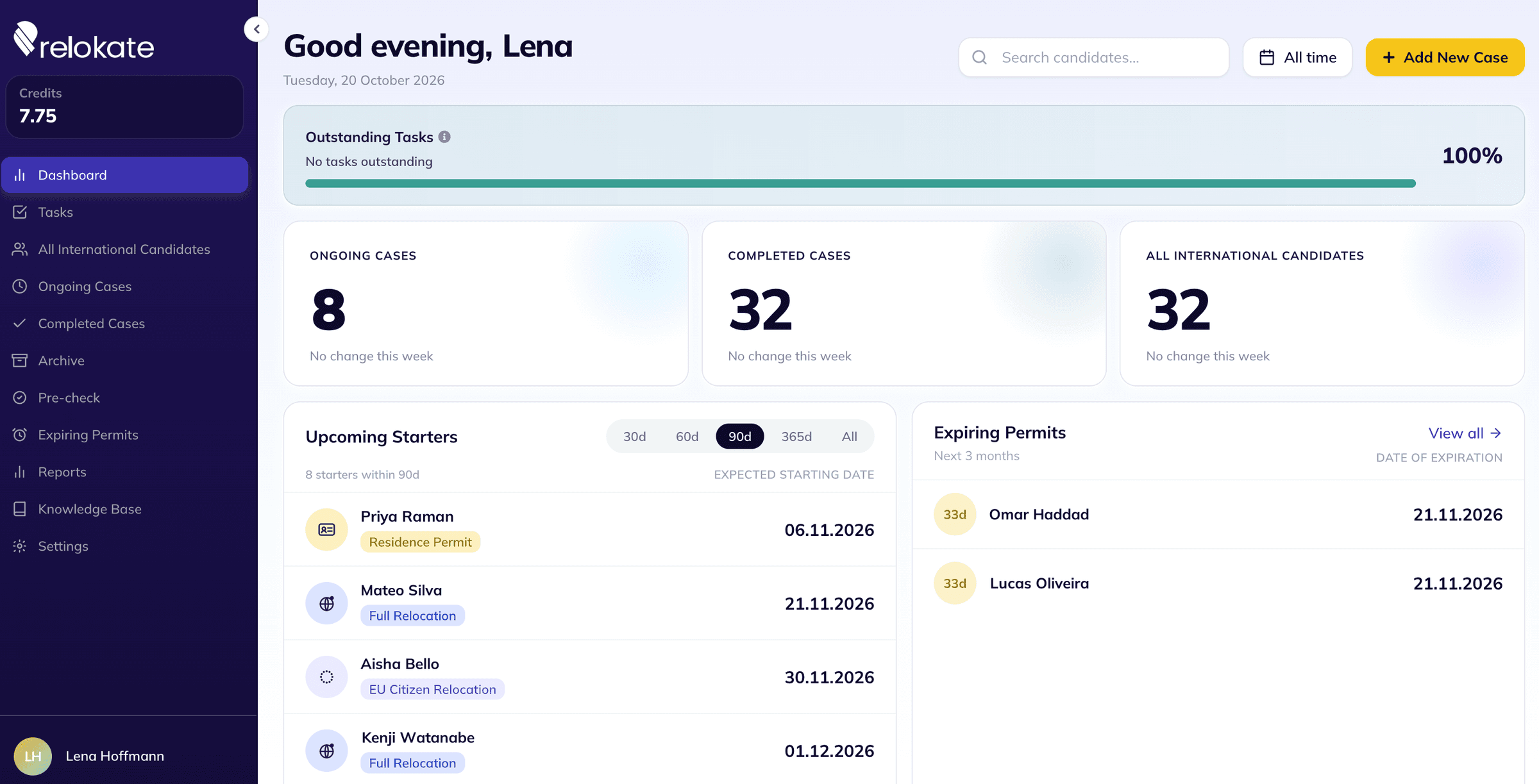
Track every case in real time — visa status, tasks, documents, and deadlines in one dashboard. Book a 30-minute demo and we'll walk you through it.
Book a call →About the author

Katharina Hilgers
Founder & Managing Director, relokate
Over a decade of experience in HR, People Operations, and global mobility. Founded relokate in 2020 after seeing firsthand how complex and fragmented the relocation process was for companies hiring internationally. Previously led international hiring at high-growth companies, managing relocations across 30+ nationalities. Today, Katharina combines strategic HR expertise with technology to make global hiring to Germany simple, compliant, and human.
Related glossary terms
Related guides
Keep reading
Immigration & Visas
EU Blue Card Germany 2026: €50,700 Salary Threshold Explained
Does your hire qualify? €50,700 general / €45,934.20 shortage roles in 2026. IT without a degree (3+ yrs experience)....
Immigration & Visas
Chancenkarte Germany: How It Works & Who Qualifies
Germany's Chancenkarte for employers: who qualifies, the points system, how much holders may work, and how the permit...
HR Guides
Employee Relocation Germany: 2026 Cost Breakdown
What relocating an international hire to Germany costs in 2026: visa fees, housing, flights, service fees, plus 6 hid...


