

German visa applications can require specific forms of document certification — but many hires need far less than teams expect, and some need almost none. Apostille, legalisation, and sworn translation are three different things, and each document type needs a specific combination — or, often, none at all. Here's what's actually required, when you can skip it, and how long each step really takes.
Good news first: you often need less than you think
- • Documents already issued in English or German usually need no translation at all.
- • A candidate who already holds apostilled or certified documents from a previous move can reuse them.
- • You only need to certify the documents the specific consulate actually asks for — not the whole list below.
One thing to remember
What matters is where a document was issued, not nationality. EU nationals don't need a visa and can start right away — no document verification at all. But a non-EU hire who graduated in another EU country still needs a visa, and any document issued outside Germany still needs verifying — a sworn German translation, and depending on the document an apostille. A degree earned in Spain, France or Hungary is no exception: “issued in the EU” doesn't make it ready to use in Germany.
Which documents need what
| Document | Sworn translation | Apostille / Legalisation | Certified copy |
|---|---|---|---|
| University degree certificate | Yes (if not EN/DE) | Yes | Yes |
| Transcript of records | Yes (if not EN/DE) | Sometimes | Yes |
| Birth certificate | Yes | Yes | Yes |
| Marriage certificate | Yes | Yes | Yes |
| Criminal record check | Yes | Yes | No (original) |
| Employment contract | Rarely (usually in EN/DE) | No | No |
| Passport | No | No | Copy only |
| CV / résumé | No | No | No |
| Cover / motivation letter | No | No | No |
| Professional licence | Yes | Yes (for regulated professions) | Yes |
Certification vs. apostille vs. translation
Apostille
An international certification that verifies a document is genuine. Issued by the designated authority in the country where the document was issued (usually a government ministry or court). Required for countries that are part of the Hague Apostille Convention (most countries). Speed varies a lot by country and authority — some issue one the same week, others take a few weeks. Where a start date is tight, expedited private services can turn one around in 1–3 business days for a premium.
Cost: €20–60 standard (€150–300+ expedited) · Time: a few days to a few weeks
Consular legalisation
For countries NOT in the Hague Convention, documents must be legalised by the German embassy in the country of origin. This is a multi-step process: local notarisation → foreign ministry authentication → German embassy legalisation. Takes longer than an apostille.
Cost: €100–300+ · Time: 4–8 weeks
Sworn translation (beglaubigte Übersetzung)
A translation made by a court-certified translator (vereidigter Übersetzer) who is authorised by a German court. The translator stamps and signs the translation, certifying its accuracy. Only sworn translations are accepted by German authorities.
Cost: €40–120 per page · Time: 3–10 days
Common rejection reason
Regular translations (even by professional agencies) are not accepted by German embassies or Ausländerbehörden. It must be a sworn translation by a court-certified translator. Check the translator's certification before commissioning.
Certification is not recognition
An apostille or legalisation only confirms a document is genuine — it does not mean the qualification is recognised in Germany. A certified degree may still need a ZAB equivalence assessment, and regulated professions (doctors, nurses, engineers) need separate recognition from the relevant state authority. Don't confuse the two: certify the paper, then recognise the qualification. See our degree recognition guide.
Requirements by document type
University degree & transcript
- Sworn translation into German (if not already in English or German)
- Apostille from the issuing country's designated authority
- Certified copy (notarised in the home country or by the embassy)
- May also need ZAB evaluation — see our degree recognition guide
Birth & marriage certificates
- Sworn translation into German
- Apostille (Hague Convention countries) or legalisation (non-Hague countries)
- Certified copy
- Must be recent — some embassies require certificates issued within 6 months
Criminal record check (Führungszeugnis)
- Must be from the country of nationality AND any country where the applicant lived 12+ months
- Sworn translation into German
- Apostille or legalisation
- Must be recent — usually less than 6 months old at the time of visa application
Employment contract
- Usually accepted in English or German — no translation needed
- No apostille or legalisation required
- Must include: job title, gross annual salary, start date, and working hours
- Both parties must sign before the visa interview
Sworn translations
Finding a court-certified translator:
- In Germany: Search the translator database at justiz-dolmetscher.de
- Abroad: Many German embassies maintain a list of approved translators. Check the embassy website.
- Online: Some court-certified translators accept orders by email and send the stamped original by post.
- Cost: €30–80 per page. A typical degree certificate + transcript: €150–300 total.
- Time: 3–7 business days. Rush service available from most translators for +50% fee.
Common mistakes that cost you time
These rarely get an application outright rejected — they just create wasted steps, extra cost, and delay. Avoid them and the process stays quick.
Translating before the apostille
The sworn translation must include the apostille stamp — so apostille first, then translate the document together with its apostille. Commissioning the translation before the apostille is issued means paying to have it redone. (Criminal record checks and other collection steps can still run in parallel — just not the final translation.)
Relying on a home-country notary for German purposes
A local notary confirming a copy is not the same as an apostille or consular legalisation. German authorities need the internationally recognised certification, not just a domestic notarial stamp.
Trying to apostille documents inside Germany
Apostilles must be issued in the country where the document was created, by that country's designated authority — never in Germany. Plan the timeline around the home country's processing speed.
Confusing authenticity with recognition
A certified degree is proven genuine, not proven equivalent. Academic degrees may still need a ZAB assessment and regulated professions need separate state recognition.
How long each step takes
Timeline is what matters for a start date — and most of it is faster than teams fear. The only step that reliably takes weeks is non-Hague legalisation. (Costs are per document and usually the employee's side of the process, so they're shown last.)
| Step | Timeline | Cost |
|---|---|---|
| Apostille (per document) | Days to a few weeks (by country) | €20–60 |
| Expedited apostille (optional) | 1–3 business days | €150–300+ |
| Embassy legalisation (non-Hague only) | 4–8 weeks | €100–300+ |
| Sworn translation (per page) | 3–10 days (skip if EN/DE) | €40–120 |
| Notarised copy | Same day | €15–40 |
| Criminal record check | 1–4 weeks | €0–50 (varies by country) |
| Typical total (single applicant) | Days to a few weeks — depends on country | €300–800 |
Free download
The German document certification one-pager
The whole process on one page — which document needs apostille, legalisation or sworn translation, typical costs and timelines, the correct order of steps, and the 4 mistakes that trigger rejections. Enter your work email to download the PDF.
No spam. Business emails only.
Complete checklist for employers
Confirm what's actually needed first
Check the specific consulate's list and what the candidate already holds. Documents already in English/German or already certified often need nothing — the real workload is usually smaller than it looks. relokate generates a per-person checklist automatically.
Check which country the documents come from
Hague Convention → apostille. Non-Hague → embassy legalisation. This determines the timeline.
Apostille first, then commission the sworn translation
The translation must include the apostille stamp, so get the apostille before translating. Translating too early means paying to redo it.
Get criminal record checks from ALL relevant countries
If the candidate lived in 3 countries, you need 3 criminal record checks. Start all of them simultaneously.
Verify document validity dates
Criminal records and some certificates expire after 3–6 months. Time the applications so they're still valid at the visa interview.
Make copies of everything
Most embassies require the original + 1–2 certified copies. Make extras in case of loss.
Key takeaway
Certification sounds intimidating, but for many hires it's quick — or barely needed. Documents already in English or German need no translation, EU-issued documents are largely exempt, and expedited apostille services exist where speed matters. The one case to spot early is non-Hague legalisation (or criminal-record checks from several countries), which genuinely runs a few weeks. So: check the consulate's list, see what the candidate already holds, and only then start what's actually required — usually far less than the worst case.
You don't have to untangle this alone
Certification can feel complicated the first time — different rules per country, a strict order of steps, and documents that expire. relokate guides both the company and the employee through every step, so nothing is missed: we tell each person exactly which documents they need, point them to the right authorities and sworn translators, sequence the apostille and translation correctly, and only submit the visa application once everything is ready. Even when it looks daunting at the start, our service makes sure it all goes smoothly — and the employee arrives ready to work on schedule.
For HR teams
Want to see how relokate handles this?
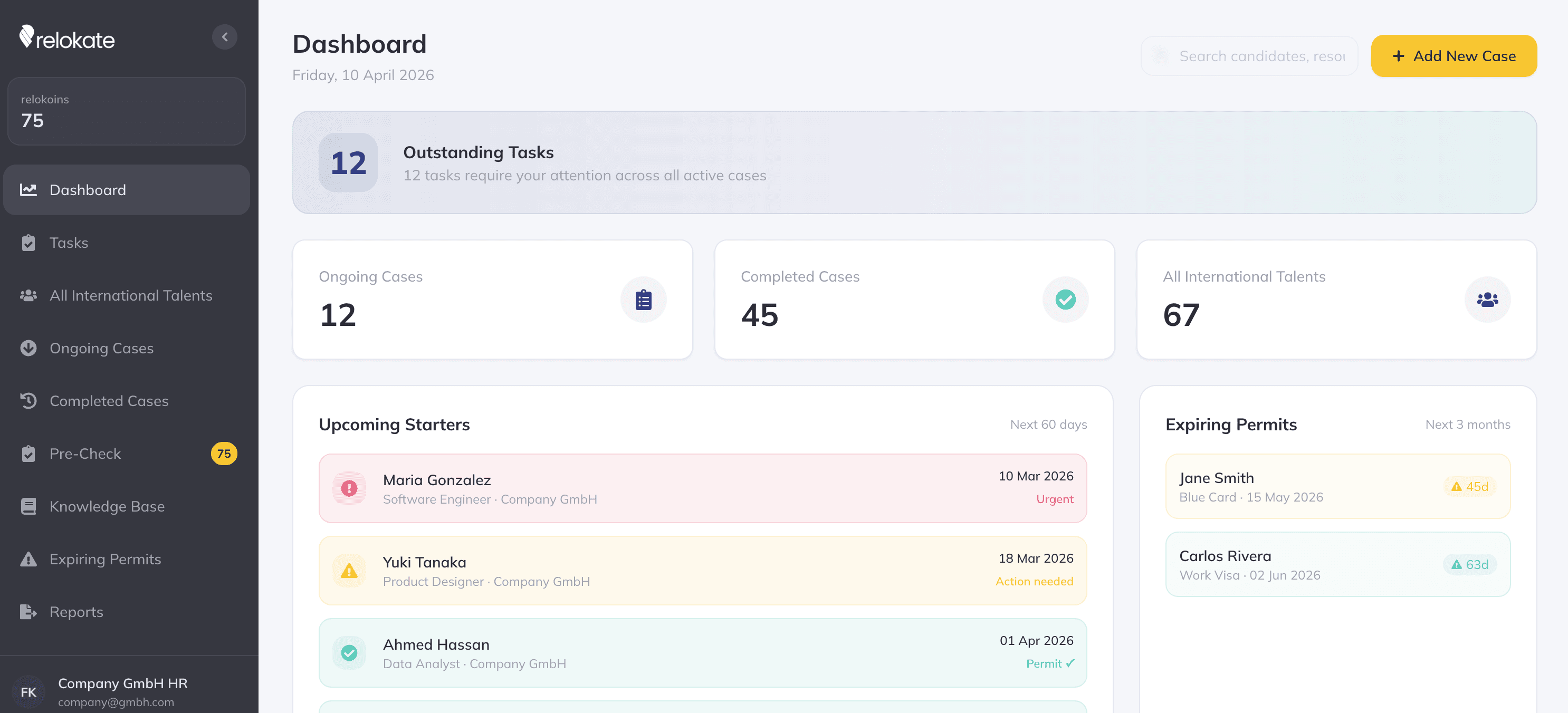
Track every case in real time — visa status, tasks, documents, and deadlines in one dashboard. Book a 15-minute call and we'll walk you through it.
Book a call →About the author

Hanna Kovacs
Product Manager, Global Mobility
Professional experience across the US, Hungary, and Germany in product management and operations. Deep expertise in German immigration law and the regulatory landscape for skilled worker migration. At relokate, Hanna owns the product roadmap, drives platform automation, and develops the compliance frameworks and immigration content that HR teams rely on.
Related glossary terms
Keep reading
Immigration & Visas
EU Blue Card Germany 2026: €50,700 Salary Threshold Explained
Does your hire qualify? €50,700 general / €45,934 shortage roles in 2026. IT without degree (3+ yrs exp). §81a fast-t...
Immigration & Visas
Degree Recognition Germany: HR Guide to Anerkennung
How to get a foreign degree recognised in Germany — ZAB, anabin, and the recognition process explained. Timelines, co...


