

When an international employee leaves your company — whether through termination, resignation, or mutual agreement — their residence permit is immediately at risk. The Ausländerbehörde must be notified, and the clock starts ticking. Here's what HR teams need to know to handle this correctly — and protect both the company and the employee.
Immediate impact on the permit
German work permits (Aufenthaltstitel) are tied to the specific employment that justified them. When the employment ends, the legal basis for the permit changes:
Critical
The employer is legally required to notify the Ausländerbehörde within 4 weeks when an international employee's contract ends. Failure to do so can result in fines and complications for future hires.
The permit doesn't expire the day the contract ends — but it enters a grace period, and the conditions depend on the permit type.
Blue Card holders
EU Blue Card holders have the most favorable rules:
- 3-month grace period to find a new employer (since the 2023 reform, extended from the previous 0 days). The Blue Card remains valid during this period.
- 6-month extension possible — if the Blue Card holder has held the card for 2+ years, the grace period extends to 6 months.
- No new visa needed — they can start working for a new employer on the existing Blue Card, provided they notify the Ausländerbehörde of the job change within the grace period.
- New employer must meet the same thresholds — salary and qualification requirements still apply for the new position.
For the first 12 months
During the first 12 months after Blue Card issuance, a change of employer must be notified to the Ausländerbehörde (§82 AufenthG), provided the new role still meets the Blue Card conditions. This is a notification — not an approval procedure. After the first 12 months, no notification is required.
Other work permit types
For employees on a standard skilled worker visa (§18a, §18b) or other work-related permits, the rules are less generous:
| Permit type | Grace period | What happens |
|---|---|---|
| §18a/18b Skilled Worker | 3 months (since 2023) | Must find new employer in same qualification area. New employer needs Ausländerbehörde approval. |
| ICT Card | No grace period | Permit is tied to the specific intra-company transfer. Ends when the assignment ends. |
| §19c(2) Experience-based | 3 months | Can seek new employment. New position needs Federal Employment Agency approval. |
| Niederlassungserlaubnis (PR) | Not affected | Permanent residents can change or lose jobs freely. No impact on permit. |
Employer obligations
German law imposes specific obligations on the employer when an international employee's contract ends:
Notify the Ausländerbehörde
Within 4 weeks of the end of employment. Use the official form (Mitteilung über die Beendigung des Beschäftigungsverhältnisses). Some cities accept email; others require post.
Notify the Federal Employment Agency (BA)
If the employee's permit required BA approval, the BA must also be notified of the termination.
Issue the Arbeitszeugnis
The employee will need their reference letter (Arbeitszeugnis) for the next employer — especially if they need to prove their qualification match for a new permit.
Inform the employee about their rights
Tell them about the grace period, their right to register as a job seeker (Agentur für Arbeit), and the deadline to find new employment.
Deadlines like these are easy to miss when nobody's job is to watch them. Compliance Watch monitors every permit and statutory employer duty for your workforce and alerts you before they become fines.
Options for the employee
An international employee who loses their job is not immediately deportable. They have options:
- Find a new employer within the grace period — the most common and simplest path. The new employer applies for a change-of-employer approval at the Ausländerbehörde.
- Switch to a job seeker visa (§20) — possible for Blue Card holders and skilled workers. Allows up to 6 months to search for a new position.
- Apply for the Chancenkarte — if they meet the points requirements, they can switch to the new Opportunity Card and search for work for up to 12 months.
- Start a business (freelance visa) — if the employee has a viable business plan, they can apply for a self-employment residence permit (§21).
- Return home — if no other option is viable, the employee should leave Germany before the grace period expires to avoid an overstay record.
HR offboarding checklist
Determine the exact end date
The grace period starts from the last day of employment, not the notice date.
Send the Ausländerbehörde notification
Within 4 weeks. Keep a copy as proof.
Notify the BA if applicable
Required if the original permit involved Federal Employment Agency approval.
Issue the Arbeitszeugnis immediately
The employee needs this for their next application. Don't delay.
Brief the employee on their grace period
Tell them the exact date it expires and what their options are.
Provide a relocation support referral
If the employee needs help navigating the job change process, refer them to an immigration specialist.
Handle health insurance transition
Public health insurance continues during unemployment registration. Private insurance may have gaps — flag this.
Return deposit / settle housing
If the company provided housing, agree on a timeline for the employee to move out.
Key takeaway
The 2023 reform introduced a 3-month grace period that didn't exist before — a major improvement for international workers. But the obligation to notify the Ausländerbehörde is non-negotiable. Handle this proactively and give your departing employee every chance to land on their feet.
For HR teams
Want to see how relokate handles this?
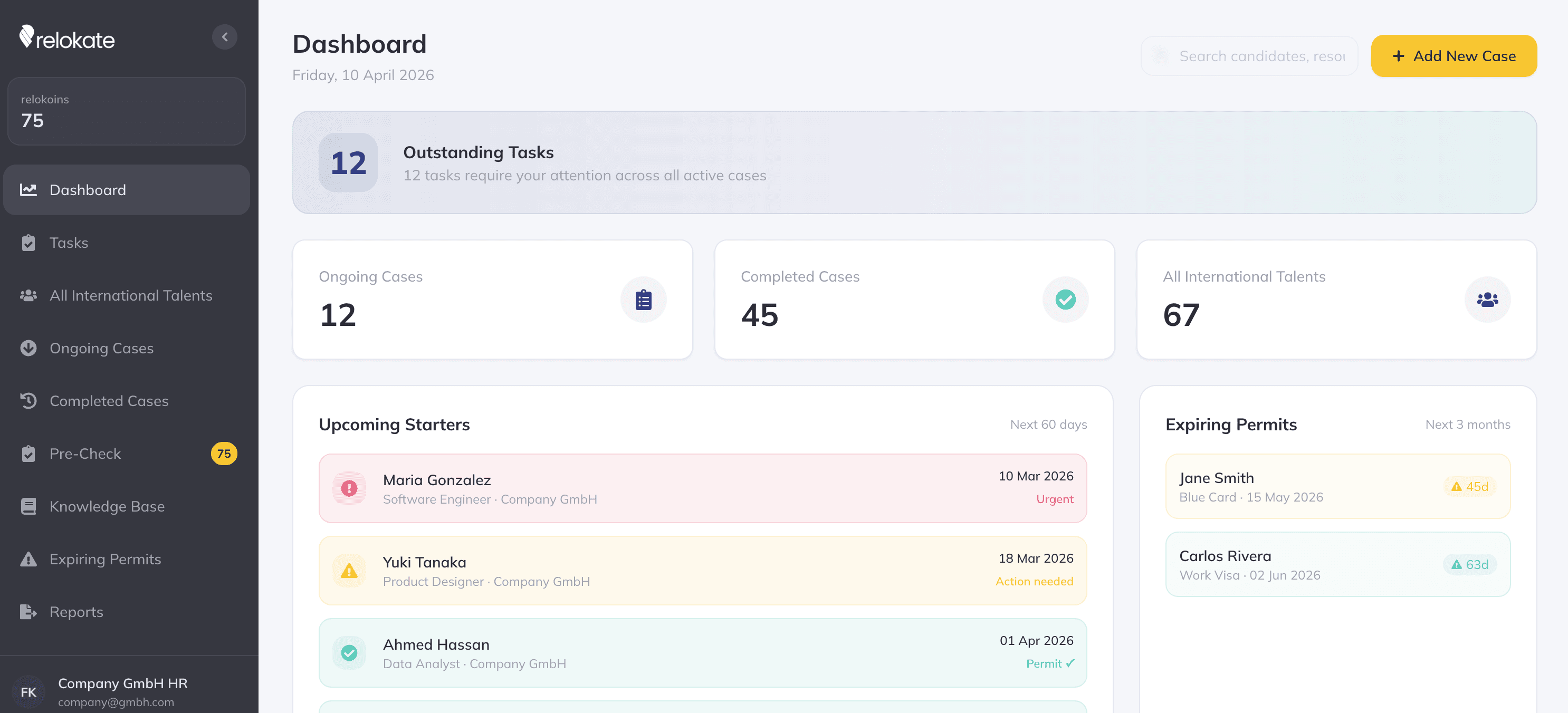
Track every case in real time — visa status, tasks, documents, and deadlines in one dashboard. Book a 15-minute call and we'll walk you through it.
Book a call →About the author

Hanna Kovacs
Product Manager, Global Mobility
Professional experience across the US, Hungary, and Germany in product management and operations. Deep expertise in German immigration law and the regulatory landscape for skilled worker migration. At relokate, Hanna owns the product roadmap, drives platform automation, and develops the compliance frameworks and immigration content that HR teams rely on.
Related glossary terms
Keep reading
Immigration & Visas
EU Blue Card Germany 2026: €50,700 Salary Threshold Explained
Does your hire qualify? €50,700 general / €45,934 shortage roles in 2026. IT without degree (3+ yrs exp). §81a fast-t...
HR Guides
Fiktionsbescheinigung: Can Your Employee Keep Working?
Whether an employee may work while their permit application is pending has to be reviewed case by case. How to avoid ...
Immigration & Visas
Germany Immigration Law 2026: Key Changes for Employers
All 2026 immigration law changes: new Blue Card thresholds (€50,700), Chancenkarte expansion, digital consular portal...


