

Internationale Fachkräfte einstellen bedeutet für deutsche Arbeitgeber: den richtigen Aufenthaltstitel wahlen, die Berufsanerkennung klaren und den Antragsprozess steuern. 2026 stehen Arbeitgebern mehrere Wege offen -- von der Blauen Karte EU über das Fachkräfteverfahren bis zur Chancenkarte. Dieser Leitfaden erklärt jeden Schritt.
Warum internationale Fachkräfte einstellen?
Deutschland fehlen laut Institut der deutschen Wirtschaft (IW) bis 2035 rund 7 Millionen Arbeitskräfte. Bereits heute können 54% der Unternehmen offene Stellen nicht besetzen (DIHK-Fachkräftereport 2025). Die Bundesregierung hat deshalb das Einwanderungsrecht grundlegend reformiert, um die Einstellung internationaler Fachkräfte zu vereinfachen.
Für Arbeitgeber bedeutet das: Wer den Prozess versteht, kann schneller einstellen als der Wettbewerb -- und auf einen globalen Talentpool zugreifen.
Welche Aufenthaltstitel gibt es für internationale Fachkräfte?
Je nach Qualifikation, Gehalt und Beruf kommen unterschiedliche Aufenthaltstitel in Frage. Hier ein Überblick über die wichtigsten Optionen für Arbeitgeber:
| Aufenthaltstitel | Voraussetzungen | Gehaltsgrenze | Niederlassungserlaubnis |
|---|---|---|---|
| Blaue Karte EU | Hochschulabschluss (oder 3J IT-Erfahrung) | 50.700 Euro / 45.934 Euro | 21-27 Monate |
| Fachkräftevisum (SS18a/b) | Anerkannter Berufs- oder Hochschulabschluss | Keine Mindestgrenze | 4 Jahre |
| Anerkennungspartnerschaft (SS16d) | Ausländischer Abschluss, Anerkennung läuft | Keine Mindestgrenze | Nach Anerkennung + 2 Jahre |
| Chancenkarte (SS20a) | Punktesystem (Qualifikation, Alter, Sprache) | Keine (Jobsuchevisum) | Nach Stellenantritt + Aufenthaltstitel |
| ICT-Karte (SS19) | Unternehmensinterne Versetzung | Vergleichbare Vergütung | Nicht möglich (befristet) |
| Westbalkan-Regelung (SS26 Abs. 2) | Staatsangehörigkeit Westbalkan, Jobangebot | Keine Mindestgrenze | 4 Jahre |
Berufsanerkennung: Wann ist sie erforderlich und wie funktioniert sie?
Die Anerkennung ausländischer Qualifikationen ist ein zentraler Schritt beim Einstellen internationaler Fachkräfte. Ob eine formale Anerkennung erforderlich ist, hängt vom Beruf und Aufenthaltstitel ab:
- Reglementierte Berufe (Ärzte, Ingenieure, Lehrer): Formale Anerkennung immer erforderlich vor Berufsausübung.
- Nicht-reglementierte Berufe (IT, Marketing, Vertrieb): Anerkennung für die Blaue Karte erforderlich (anabin-Eintrag oder ZAB-Bescheinigung), nicht für den Beruf selbst.
- Anerkennungspartnerschaft (SS16d): Neuheit seit 2024 -- die Fachkraft kann einreisen und arbeiten, während das Anerkennungsverfahren in Deutschland läuft.
Wichtige Anlaufstellen für die Anerkennung
| Stelle | Zustandig für | Dauer |
|---|---|---|
| anabin (kmk.org) | Schnellcheck Hochschulabschluss | Sofort (Datenbank) |
| ZAB (Zentralstelle für auslandisches Bildungswesen) | Formale Zeugnisbewertung | 4-8 Wochen |
| IHK FOSA | Anerkennung Berufsabschlusse (IHK-Berufe) | 3-4 Monate |
| Handwerkskammern | Anerkennung Handwerksberufe | 3-4 Monate |
Beschleunigtes Fachkräfteverfahren: So funktioniert die Uberholspur
Das beschleunigte Fachkräfteverfahren nach SS81a AufenthG ermoglicht es Arbeitgebern, den gesamten Einwanderungsprozess zu beschleunigen. Der Arbeitgeber -- nicht der Kandidat -- stellt den Antrag bei der zuständigen Ausländerbehörde.
Vollmacht und Antragstellung
Der Arbeitgeber erhalt eine Vollmacht vom Kandidaten und stellt den Antrag bei der Ausländerbehörde. Kosten: 411 Euro.
Behordliche Koordination
Die Ausländerbehörde koordiniert mit der Bundesagentur für Arbeit (Vorabzustimmung) und ggf... der Anerkennungsstelle.
Vorabzustimmung (max. 3 Wochen)
Die Ausländerbehörde erteilt eine Vorabzustimmung und ubermittelt diese an die Botschaft.
Bevorzugter Botschaftstermin
Der Kandidat erhalt innerhalb von 3 Wochen einen Visatermin bei der Botschaft -- statt der ublichen 2-8 Wochen Wartezeit.
Visum in 3 Wochen
Die Botschaft entscheidet innerhalb von 3 Wochen über den Visumantrag.
Praxis-Tipp
Das beschleunigte Verfahren lohnt sich besonders, wenn der Kandidat aus einem Land mit langen Botschaftswartezeiten kommt (z.B. Indien, Nigeria, Turkei). Gesamtdauer mit Verfahren: ca. 4-8 Wochen statt 3-5 Monate.
§45c AufenthG: Die Hinweispflicht seit Januar 2026
Seit dem 1. Januar 2026 gilt die Hinweispflicht nach §45c AufenthG (Faire Integration). Sie betrifft Arbeitgeber, die Drittstaatsangehörige aus dem Ausland einstellen:
- Hinweispflicht (Faire Integration): Drittstaatsangehörige, die aus dem Ausland eingestellt werden, müssen bis zum ersten Arbeitstag in Textform auf das kostenlose Beratungsangebot „Faire Integration“ (§45b AufenthG) hingewiesen werden.
- Kein Bußgeld: Ein Bußgeld ist daran derzeit nicht geknüpft — §45c steht nicht im Bußgeldkatalog des §98 AufenthG. Es bleibt eine gesetzliche Pflicht, deren Versäumnis bei einer Prüfung auffallen kann.
- Best Practice: Den Hinweis als festen Onboarding-Standard für jede Einstellung dokumentieren — der Wohnsitzstatus bei Vertragsschluss ist nicht immer eindeutig verifizierbar.
- Fair Integration: Die Bundesregierung baut Beratungsstellen aus, die sowohl Fachkräfte als auch Arbeitgeber zu arbeitsrechtlichen Fragen beraten.
Kosten für Arbeitgeber: Was kostet es, eine internationale Fachkraft einzustellen?
Die Kosten variieren je nach Aufenthaltstitel und individüllem Fall. Hier ein typischer Kostenrahmen:
| Kostenpunkt | Kosten (ca.) | Wer zahlt typischerweise |
|---|---|---|
| Visumgebuhr (Botschaft) | 75 Euro | Kandidat oder Arbeitgeber |
| Aufenthaltstitel (Ausländerbehörde) | 100-150 Euro | Kandidat oder Arbeitgeber |
| ZAB-Zeugnisbewertung | 200 Euro | Arbeitgeber |
| Beschleunigtes Fachkräfteverfahren | 411 Euro | Arbeitgeber |
| Berufsanerkennung (IHK FOSA) | 420-600 Euro | Arbeitgeber |
| Relocation-Service (z.B. relokate) | ab 1.500 Euro | Arbeitgeber |
| Gesamt (typisch) | 2.000-3.500 Euro | Uberwiegend Arbeitgeber |
Zum Vergleich: Die durchschnittlichen Kosten einer unbesetzten Stelle in Deutschland betragen laut Stepstone-Studie 29.000 Euro pro Quartal. Die Investition in ein strukturiertes Einwanderungsverfahren rechnet sich in der Regel schnell.
Typischer Ablauf: Vom Jobangebot bis zum ersten Arbeitstag
Arbeitsvertrag unterschreiben
Vertrag mit Bruttojahresgehalt, Stellenbeschreibung und Startdatum. Gleichzeitig: ZAB-Anerkennung anstossen, falls nötig.
Aufenthaltstitel wahlen und Unterlagen zusammenstellen
Blaue Karte, Fachkräftevisum oder Anerkennungspartnerschaft? Dokumenten-Checkliste an den Kandidaten senden.
Beschleunigtes Fachkräfteverfahren starten (optional)
Arbeitgeber stellt Antrag bei der Ausländerbehörde mit Vollmacht des Kandidaten. Kosten: 411 Euro.
Vorabzustimmung und Botschaftstermin
Ausländerbehörde erteilt Vorabzustimmung. Kandidat erhalt bevorzugten Botschaftstermin.
Visumerteilung und Einreise
D-Visum wird erteilt. Kandidat reist ein und kann sofort arbeiten.
Anmeldung und Ausländerbehörde
Wohnsitz anmelden (innerhalb 14 Tagen), Termin bei der Ausländerbehörde für den Aufenthaltstitel.
Aufenthaltstitel erhalten
Blue Card oder Fachkräftevisum wird erteilt. Sozialversicherung, Bankkonto und Steuer-ID sind in der Regel bereits eingerichtet.
Häufig gestellte Fragen zum Einstellen internationaler Fachkräfte
Wie stelle ich eine ausländische Fachkraft in Deutschland ein?
Der Prozess umfasst vier Schritte: (1) Arbeitsvertrag abschliessen, (2) den passenden Aufenthaltstitel wahlen (Blaue Karte, Fachkräftevisum, Anerkennungspartnerschaft), (3) ggf... das beschleunigte Fachkräfteverfahren starten, (4) den Kandidaten bei Visum, Anmeldung und Ausländerbehörde unterstutzen. Mit dem beschleunigten Verfahren dauert der Prozess ca. 8-12 Wochen.
Braucht der Kandidat immer eine Berufsanerkennung?
Nicht immer. Für die Blaue Karte EU reicht eine anabin-Prüfung oder ZAB-Bescheinigung des Hochschulabschlusses. Für reglementierte Berufe (z.B. Ärzte, Ingenieure) ist eine formale Berufsanerkennung zwingend. Seit 2024 gibt es die Anerkennungspartnerschaft: Die Fachkraft kann einreisen und arbeiten, während das Anerkennungsverfahren in Deutschland läuft.
Was kostet es, einen internationalen Mitarbeiter einzustellen?
Die reinen Behörden- und Anerkennungskosten liegen bei 300-800 Euro. Mit Relocation-Service (Wohnungssuche, Behordengange, Onboarding-Unterstutzung) sollten Arbeitgeber insgesamt mit 2.000-3.500 Euro rechnen. Zum Vergleich: Eine unbesetzte Stelle kostet durchschnittlich 29.000 Euro pro Quartal.
Was ist das beschleunigte Fachkräfteverfahren?
Das beschleunigte Fachkräfteverfahren (SS81a AufenthG) ermoglicht Arbeitgebern, den Visumprozess deutlich zu verkurzen. Der Arbeitgeber stellt den Antrag bei der Ausländerbehörde, die mit Botschaft und Bundesagentur für Arbeit koordiniert. Kosten: 411 Euro. Zeitersparnis: ca. 6-10 Wochen.
Welche neuen Pflichten haben Arbeitgeber 2026?
Seit dem 1. Januar 2026 gilt die Hinweispflicht nach §45c AufenthG: Arbeitgeber müssen Drittstaatsangehörige, die aus dem Ausland eingestellt werden, bis zum ersten Arbeitstag in Textform auf das Beratungsangebot „Faire Integration“ hinweisen. Ein Bußgeld ist daran derzeit nicht geknüpft — §45c steht nicht im Bußgeldkatalog des §98 AufenthG; als Best Practice gehört der Hinweis dennoch in jedes Onboarding.
Kann ich Fachkräfte auch ohne Hochschulabschluss einstellen?
Ja. Seit 2023 können IT-Fachkräfte mit 3+ Jahren Erfahrung die Blaue Karte erhalten. Für andere Berufe gibt es das Fachkräftevisum nach SS18a (mit anerkannter Berufsausbildung) und die Anerkennungspartnerschaft nach SS16d (Einreise während laufendem Anerkennungsverfahren). Zudem ermoglicht die Westbalkan-Regelung die Einstellung ohne Qualifikationsanforderungen.
Zusammenfassung für Arbeitgeber
- Aufenthaltstitel: Blaue Karte EU, Fachkräftevisum, Anerkennungspartnerschaft, Chancenkarte -- je nach Qualifikation
- Beschleunigung: Fachkräfteverfahren (SS81a) verkurzt den Prozess auf 4-8 Wochen
- Kosten: 2.000-3.500 Euro inkl. Relocation-Service
- Timeline: 8-14 Wochen vom Vertrag bis zum ersten Arbeitstag
- Neue Pflicht 2026: §45c-Hinweispflicht (Faire Integration) bei Einstellungen aus dem Ausland — kein Bußgeld, aber gesetzliche Pflicht
Sie möchten internationale Fachkräfte einstellen und den Prozess auslagern? relokate ubernimmt das gesamte Einwanderungsverfahren -- von der Aufenthaltstitelberatung über die Berufsanerkennung bis zur Anmeldung in Deutschland.
Für HR-Teams
Wie übernimmt relokate das?
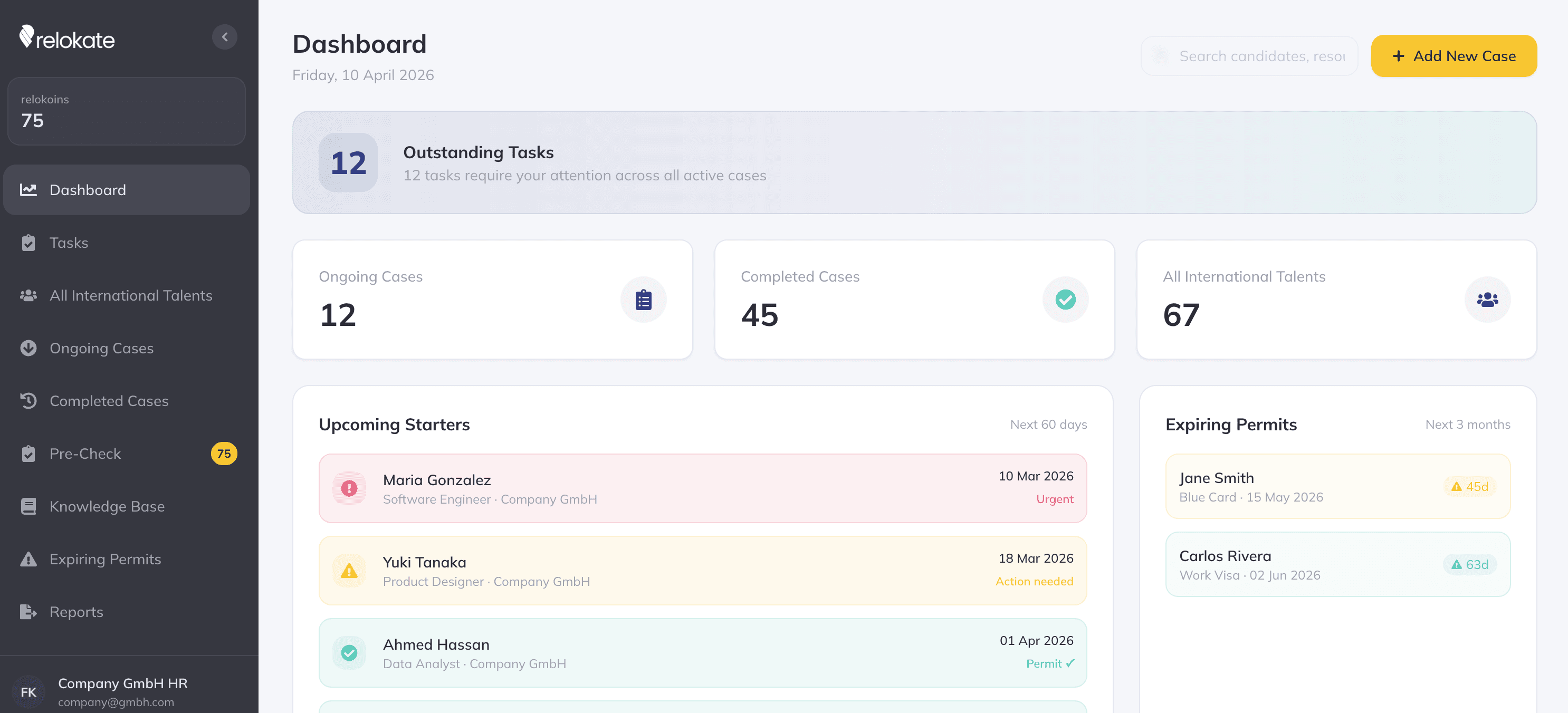
Jeden Fall in Echtzeit verfolgen — Visa-Status, Aufgaben, Dokumente und Fristen in einem Dashboard. 15-Min-Call buchen und wir zeigen es Ihnen.
Termin buchen →Über den Autor

Katharina Hilgers
Founder & Managing Director, relokate
Over a decade of experience in HR, People Operations, and global mobility. Founded relokate in 2020 after seeing firsthand how complex and fragmented the relocation process was for companies hiring internationally. Previously led international hiring at high-growth companies, managing relocations across 30+ nationalities. Today, Katharina combines strategic HR expertise with technology to make global hiring to Germany simple, compliant, and human.
Verwandte Glossar-Begriffe
Weiterlesen
Einwanderung & Visa
Blaue Karte EU 2026: Gehalt & Antragsprozess
Blaue Karte EU 2026: Gehaltsgrenze 50.700 € / 45.934 € Mangelberufe, IT ohne Studium, Antragsprozess und Weg zur Nied...
HR-Leitfäden
Relocation-Kosten Deutschland 2026: Kompletter Überblick
Was kostet die Versetzung eines internationalen Mitarbeiters nach Deutschland? Visa, Unterkunft, Flüge und versteckte...


