

Summer changes the rhythm of every HR team. Annual-leave requests pile up, and alongside them a newer kind of request — employees asking to work remotely from abroad for a few weeks. Approving the time off is the easy part. The part that rarely makes it onto anyone’s to-do list is the compliance responsibility that rides along with each request. For your international employees, getting it wrong isn’t just about cost — it can mean trouble entering the country, an uncomfortable situation at the airport, or a compliance risk that lands right back on your desk.
Key takeaways
- Two scenarios, one shared rule: whether an employee works abroad or just holidays abroad, the passport and residence permit must stay valid through the trip and reentry
- Passport: valid at least 6 months beyond the intended return date
- Time abroad varies by permit: a standard residence permit lapses after ~6 months abroad; an EU Blue Card allows ~12 months — always check the individual title
- Holiday travel needs the document checks, reentry, and insurance — nothing more
- Remote work abroad adds tax, social-security (A1), local work-authorisation, and GDPR checks — and is your decision to approve
- A Fiktionsbescheinigung only allows travel if it explicitly says so — an employee whose permit is mid-renewal must confirm the wording before leaving Germany
Written for HR, global mobility, and immigration teams. Reflects current German rules in 2026. General information, not legal, tax, or immigration advice — verify each case individually.
A summer trip abroad doesn’t create the same to-do list for every employee. It helps to split the checks HR needs to run into two kinds — and keep them separate: immigration compliance (can the employee leave Germany and get back in?) and additional compliance (tax, social security, data protection), which only kicks in when they are actually working abroad.
Layer 1 — Immigration compliance: leaving Germany and getting back in
| Employee | Holiday travel abroad | Remote work abroad |
|---|---|---|
| German nationals | Valid passport or ID card — otherwise free to leave and return | Same, plus the destination country decides whether remote work is allowed there (some require a local work visa) |
| EU / EEA nationals | Free movement — a valid passport or ID card is all that’s needed to return | Same, plus the destination country’s rules on remote work |
| Non-EU on a German residence permit ← this guide | Valid passport and valid German residence permit, within the permit’s time-abroad limit, for lawful reentry | All of the above, plus the destination country’s rules on remote work |
Layer 2 — Additional compliance: only when they’re working abroad
This layer is triggered by working abroad, not by nationality — it applies the same to German, EU, and non-EU employees, and not at all to a pure holiday:
- Tax & permanent-establishment risk in the destination country
- Social security — an A1 certificate within the EU/EEA/Switzerland
- GDPR & IT-security duties
- A written remote-work agreement
What this guide focuses on is the immigration layer unique to the highlighted row: your non-German, non-EU employees who live and work in Germany on a residence permit — a work permit, an EU Blue Card, a Skilled Worker permit, or permanent residency. For them, a passport or residence permit that lapses at the wrong moment doesn’t mean a rescheduled flight — it can mean being refused reentry to Germany, or losing their residence status altogether.
Over the summer those requests arrive in two shapes — an employee who wants to work remotely from abroad, and an employee simply taking holiday abroad. Both rest on the same non-negotiable: a valid passport and a valid residence permit for the whole trip and the moment of reentry. We’ve pulled together the key things HR should keep in mind for each, so nothing slips through before the summer rush.
Two situations, one non-negotiable
Requests to spend time abroad fall into two categories, and they carry very different obligations:
🏖️ Holiday travel abroad
The employee takes annual leave and travels — a week in Mallorca, a trip home. They are not working. The only question is whether they can lawfully leave and re-enter Germany. This is an immigration check, not an approval decision.
💻 Remote work abroad
The employee wants to keep working while abroad (a “workation”). This is your decision to approve or decline, and it triggers a second layer of obligations — tax, social security, local work rules, and data protection — on top of the same immigration checks.
Both scenarios rest on the same foundation, so start there — then apply the extra remote-work layer only when the employee will actually be working.
The foundation both share: passport, permit, and getting back in
Whatever the reason for the trip, two documents decide whether an employee gets back into Germany: their passport and their German residence permit (Aufenthaltstitel). If either is invalid — or expires while they are away — they may be unable to board the flight home, may be stopped at the German border, or may find their residence status has lapsed.
- Passport valid at least 6 months beyond the intended return date
- Residence permit (eAT) valid for the whole trip and at the moment of reentry, with a buffer for delays
- Employee carries the originals at all times — passport, residence permit (eAT), and the Zusatzblatt (the supplementary sheet issued with the eAT that states the permit's conditions, e.g. work authorisation)
- Reentry confirmed: valid passport + valid permit must be presented at the German border
Special case: an employee whose permit is mid-renewal
If an employee’s permit has expired while a renewal or new permit is still being processed, travelling has its own rules — a standard Fiktionsbescheinigung keeps them legal in Germany but does not automatically allow re-entry. It’s a common trip-wire, so we cover it in full below: see Travelling while an employee is between permits.
How long can an employee stay abroad? By permit type
A residence permit can lapse simply because of time spent outside Germany — even if the card’s printed expiry date is still far off. How much time is allowed depends on the type of permit the employee holds. The figures below are the common defaults, but the exact window is set case by case, and the immigration authority can grant a longer re-entry deadline on request before departure.
| Permit type | Typical time abroad before it lapses |
|---|---|
| Standard residence permit (Aufenthaltserlaubnis) | ~6 months |
| Skilled Worker permit (§18a / §18b) | ~6 months (it is a standard residence permit) |
| EU Blue Card (§18g) & family members | ~12 months |
| Settlement permit (Niederlassungserlaubnis) | ~6 months (stronger protection after long residence) |
| Permanent residence – EU (Daueraufenthalt-EU) | ~12 months outside the EU |
These absence rules sit in §51 AufenthG. Because individual circumstances and authority decisions vary, always verify the allowed period for each employee’s specific permit — don’t assume the six-month rule applies to everyone, and don’t assume a Blue Card holder can stay away indefinitely. A permit that lapses abroad usually cannot simply be reactivated at the border.
That table answers one question — how long an employee can be away from Germany before the German permit lapses. A different limit governs how long they can stay inside another country: a German residence permit lets them travel visa-free to other Schengen states, but only for up to 90 days in any 180-day period (the same short-stay allowance Schengen visitors get). So even when the German permit is safe, the destination’s 90/180 clock still runs.
Good to know this summer: longer waits at the airport
In April 2026 the EU switched on a new automated entry/exit system at airports and borders (called the EES) that registers non-EU travellers electronically instead of stamping passports. Through the summer it has caused long queues at major airports, and some travellers have missed connecting flights. Employees on a German residence permit don’t have to register in the system, but it’s worth reminding them to leave extra buffer time at the airport.
Scenario 1 — Holiday travel abroad
This is the simpler case: the employee takes leave, travels, and returns. They are not working, so there are no tax, social-security, or data-protection questions to resolve. What matters is that they can lawfully leave and re-enter. On top of the shared foundation above, add two checks:
- Travel insurance covering medical emergencies and disruptions for the full trip — company coverage is often limited abroad
- Destination entry rules and current advisories from the German Federal Foreign Office (Auswärtiges Amt), which can change at short notice
In practice, the holiday case comes down to one thing HR should never wave through on trust: is the residence permit valid through the return date, and is the employee staying within the time abroad their permit allows? If yes, they are clear to travel. If the permit expires while they are away, the trip becomes a re-entry problem — see the Auswärtiges Amt travel advisories and confirm the timeline before leave is approved.
Duty of care: travel safety
This one applies to any trip — holiday or work. Germany’s Federal Foreign Office (Auswärtiges Amt) publishes country-by-country travel & safety advisories and, for serious situations, formal travel warnings (Reisewarnungen) covering conflict, disease outbreaks, and natural disasters. Before approving travel, it’s worth checking these and proactively sharing the relevant warning with your employee — a simple duty-of-care step so no one heads into a region affected by something they hadn’t heard of.
Scenario 2 — Remote work abroad
A “workation” is not tax-neutral, and it is your decision to approve. It includes everything in the holiday checklist — valid passport, valid permit, time-abroad limit, reentry, insurance — plus a second layer, because the employee is not just present in another country, they are working there.
- Confirm the employee has the legal right to work remotely from the destination — some countries require a permit or digital-nomad visa even for short remote stays
- Income tax: working abroad can trigger income-tax obligations in the destination country — assess with a tax adviser before approval
- Permanent establishment: an employee working from another country can create a taxable presence (permanent establishment) for the company there
- Employment law: check whether the destination country's local employment law applies to the employee while they work from there
- Apply for an A1 certificate where the employee works from another EU/EEA state or Switzerland, to keep them in the German social-security system
- Confirm GDPR and IT-security compliance — data-protection and confidentiality duties apply in full abroad, and extra care is needed outside the EU/EEA
- Put an approved, written remote-work agreement in place setting out duration and location
The A1 certificate deserves a line of its own. Within the EU/EEA and Switzerland, the A1 certificate confirms an employee working temporarily in another member state stays covered by German social security, so they are not liable for contributions in two countries at once. Apply for it before the stay begins.
Travelling while an employee is between permits
This is the case relokate sees go wrong most often, and it deserves more than a warning box. The setup: an employee’s residence permit has already expired, but they applied in time for a renewal or a new permit and it is still being processed. They are approved to be here — but can they travel? The answer turns entirely on one document, the Fiktionsbescheinigung, and on what it says.
The “fiction” keeps them legal — but not mobile
When an employee applies to extend or change their permit before it runs out, German law treats their stay as lawful while the authority decides — the continuation fiction under §81 AufenthG. This protection is triggered automatically, and on its own it may come with no certificate at all. Where a Fiktionsbescheinigung is issued, it works as proof that the application is pending — it keeps the employee safe to stay in Germany and safe to stay employed. What it does not automatically do is grant a right to travel: the document that officially certifies their status — the residence permit — has expired, so a standard Fiktionsbescheinigung is not a travel document.
To travel, request a Fiktionsbescheinigung that explicitly allows it
If the employee needs to leave and re-enter Germany while between permits, they must request a Fiktionsbescheinigung from the immigration office (Ausländerbehörde) that expressly states travel and re-entry are permitted. A certificate that doesn’t say so will not get them back in — they can be turned away at the border. Two things to check on the certificate itself:
- Travel wording — it must explicitly permit travel and re-entry to Germany, not just confirm a pending application
- Its own expiry date — a Fiktionsbescheinigung is time-limited; make sure it stays valid for the whole trip, with a buffer
Request it in due time — every office is different
There is no single national procedure. Each Ausländerbehörde handles these requests its own way, and turnaround varies widely — some issue on the spot, others take weeks, and some send the certificate by post, which adds more time still. So request the travel-enabled Fiktionsbescheinigung well before any planned trip, explaining that travel is required. The worst outcome is a booked summer holiday and a certificate that hasn’t arrived in time. Preparing early is the whole game here — especially over the summer, when both the offices and your employees are at their busiest.
Travel is only half of what a Fiktionsbescheinigung governs — whether the employee may work during processing is a separate question, and it turns on which paragraph of §81 AufenthG the office has ticked. We break that down in full in Fiktionsbescheinigung: can your employee keep working?
Free download
Summer Travel Compliance Checklist
Both scenarios on one page — the shared passport, permit, and reentry checks, the time-abroad limits by permit type, and the extra tax, A1, and GDPR layer for remote work. Enter your work email to download the PDF.
No spam. Business emails only.
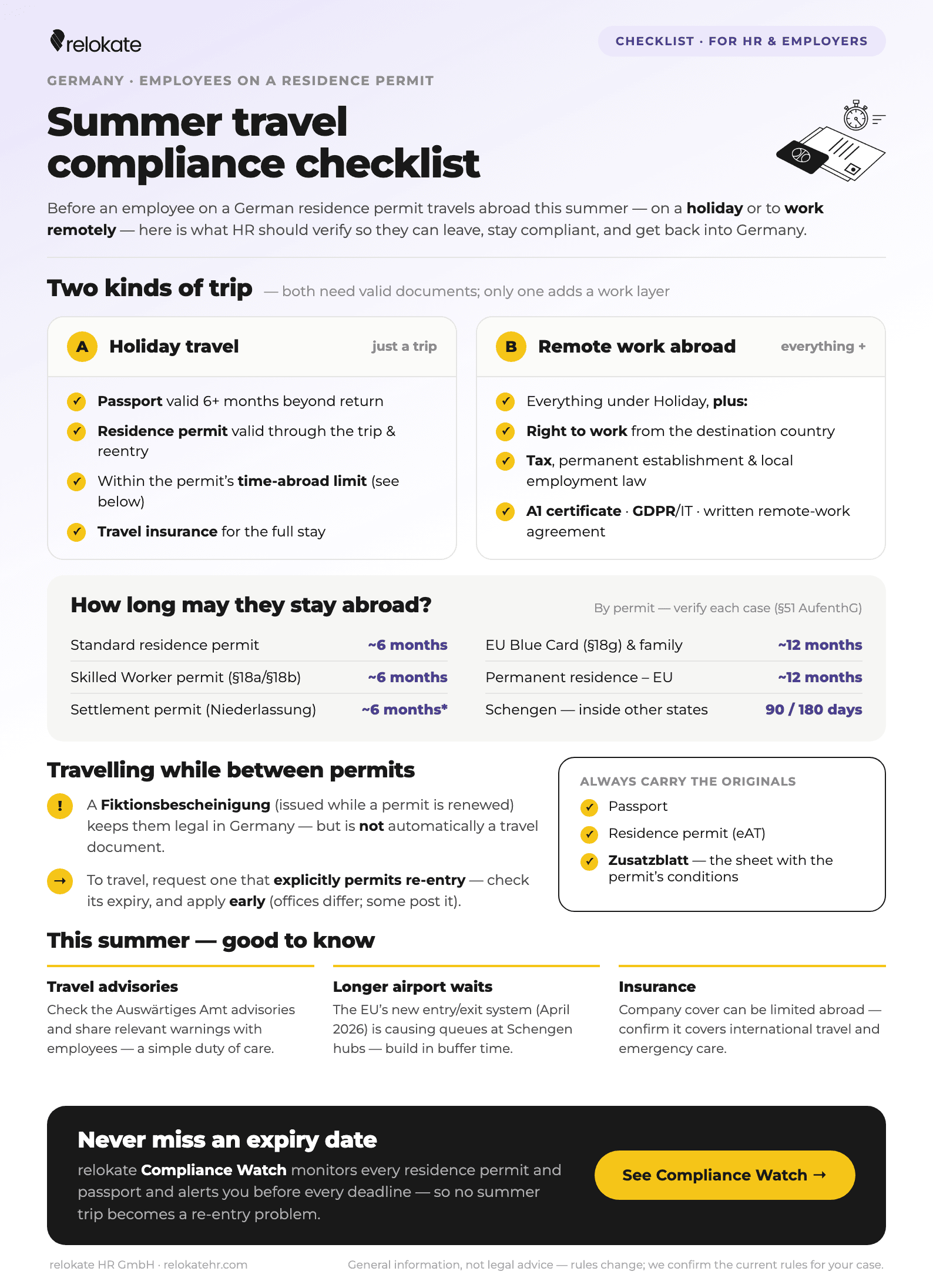
The HR checklist at a glance
Run this before approving any time abroad for an employee on a German residence permit. Every holiday check also applies to remote work — remote work just adds the right-hand column.
🏖️ Holiday travel (the baseline)
- Passport valid 6+ months beyond return
- Residence permit valid through the trip and reentry
- Time abroad within the permit’s limit (see table)
- Reentry documents confirmed (passport + valid permit)
- Travel insurance covering the full stay
- Destination entry rules & advisories checked
💻 Remote work abroad (everything left, plus)
- Legal right to work remotely from that country
- Destination visa / digital-nomad rules checked
- Tax and permanent-establishment risk assessed
- A1 certificate applied for (EU/EEA/Switzerland)
- GDPR and IT-security policy confirmed
- Written remote-work agreement in place
How relokate helps: never miss an expiry date
The checks above are only as good as the day you run them. Passports and residence permits expire on their own schedule, and the risk isn’t forgetting to check once — it’s forgetting to check again before the next trip. relokate’s software supports companies and their international employees with exactly this: we automatically monitor the validity of residence permits and passports, remind you before deadlines, advise on the documentation needed for reentry to Germany, and support employees through residence-permit applications and renewals.
Compliance Watch
Permits, passports, and employer duties — monitored for you, with alerts before every deadline so no expiry date slips through before summer travel. See how Compliance Watch works →
For related reading, see our guides on residence permits after a job change and the EU Blue Card, whose absence rules differ from a standard work permit.
Legal Disclaimer: The information provided here and on relokate’s website is for general informational purposes only and does not constitute legal advice.
Frequently asked questions
What is the difference between an employee working abroad and holidaying abroad, for compliance?
+
Both require a valid passport and a residence permit that stays valid through the trip and reentry, and both must respect the time-abroad limit of the permit. Holiday travel stops there — the employee is not working, so there are no tax, social-security, or data-protection questions. Remote work adds that second layer: local work-authorisation, income-tax and permanent-establishment risk, an A1 certificate within the EU/EEA, GDPR and IT-security compliance, and a written remote-work agreement. Remote work is also the employer's decision to approve; lawful holiday travel generally is not.
How long can an employee stay outside Germany without losing their residence permit?
+
It depends on the permit. A standard residence permit — including a Skilled Worker permit under §18a/§18b — generally lapses after about six months abroad. An EU Blue Card and the permits of the holder's family members allow about twelve months. Settlement permits (Niederlassungserlaubnis) have the six-month default with stronger protections after long residence, and the EU permanent-residence permit (Daueraufenthalt-EU) allows about twelve months outside the EU. These sit in §51 AufenthG; the exact period is set case by case, and the immigration authority can grant a longer deadline on request before departure. Always verify the individual permit.
Do employees need an A1 certificate to work remotely from another EU country?
+
Where an employee works temporarily from another EU/EEA member state or Switzerland, an A1 certificate confirms they remain in the German social-security system and are not liable for contributions in two countries at once. Apply for it before the stay begins. It is not relevant for a pure holiday, where the employee is not working.
Can an employee travel and re-enter Germany on a Fiktionsbescheinigung if their permit expired?
+
It depends on what the certificate says. If an employee's permit has expired while their extension or new permit is still being processed, they can still travel — but only if their Fiktionsbescheinigung explicitly allows re-entry. A Fiktionsbescheinigung is a bridging document that keeps the stay lawful during processing; not every version permits re-entry to Germany. Some are issued automatically when a permit lapses, but for travel the employee should request one explicitly from the immigration office (Ausländerbehörde), explain that they need to travel, and confirm that the certificate states re-entry is permitted. Travelling on a Fiktionsbescheinigung that does not expressly allow re-entry risks being refused return at the border, so check the wording before any trip is booked.
What passport validity is needed to travel from Germany?
+
Confirm the passport is valid for at least six months beyond the intended return date. Many airlines and border authorities enforce this margin, and a passport expiring soon after the trip can prevent the employee from boarding a return flight.
About the author

Katharina Hilgers
Founder & Managing Director, relokate
Over a decade of experience in HR, People Operations, and global mobility. Founded relokate in 2020 after seeing firsthand how complex and fragmented the relocation process was for companies hiring internationally. Previously led international hiring at high-growth companies, managing relocations across 30+ nationalities. Today, Katharina combines strategic HR expertise with technology to make global hiring to Germany simple, compliant, and human.
Related glossary terms
Keep reading
HR Guides
Fiktionsbescheinigung: Can Your Employee Keep Working?
Whether an employee may work while their permit application is pending has to be reviewed case by case. How to avoid ...
HR Guides
Residence Permit After Job Loss: HR Obligations
What happens to a Blue Card or work visa when employment ends? 3–12 month search window, employer notification duty, ...
Immigration & Visas
EU Blue Card Germany 2026: €50,700 Salary Threshold Explained
Does your hire qualify? €50,700 general / €45,934 shortage roles in 2026. IT without degree (3+ yrs exp). §81a fast-t...


