

Key Takeaways
- Chancenkarte holders are already in Germany — no visa appointment, no consular wait, available now.
- During the search phase: max. average 20 hours/week (§20a AufenthG) + up to two weeks' trial work per employer (Probebeschäftigung) — no BA approval required for either.
- Converting to a Blue Card: at ≥€50,700 no BA approval; at €45,934.20 (shortage occupations or recent graduates) BA approval required. No formal degree (§18g Abs. 2): always BA approval.
- No family reunification during the Chancenkarte — it opens at permit conversion.
- Give the §45c notice (Faire Integration) in writing on day one — recommended as standard practice since residency status at contracting is not always verifiable.
Germany's Chancenkarte (§20a AufenthG) is a points-based job-search residence title that lets qualified non-EU professionals enter Germany for up to one year to look for work — without a job offer. Most public coverage stops at the candidate side. This guide is for HR teams and employers considering or actively hiring a Chancenkarte holder. relokate handles both sides — candidate-side Chancenkarte process and employer-side permit conversion and compliance coordination — for clients from Volkswagen to KoRo, with over 1,500 relocations to date.
How to identify Chancenkarte holders in your pipeline
Chancenkarte holders are non-EU professionals already in Germany under §20a AufenthG (the Skilled Immigration Act's job-search permit). Confirm their status from the residence title (Aufenthaltstitel): it will name Chancenkarte as the permit type and reference §20a AufenthG.
Two practical signals for HR teams: they can come from any sourcing channel — LinkedIn, employee referral, direct application — because they're already in Germany. No visa appointment, no consular wait before you can meet them.
Anyone showing up with a Chancenkarte has already cleared the consular qualification check. Their credentials have been reviewed — which means permit conversion is typically faster and lower-risk than sponsoring a hire from abroad from scratch.
How to employ a Chancenkarte holder
The Chancenkarte is a job-search residence title (Aufenthaltstitel), not a work permit. Until conversion, two constraints govern what you can offer.
Working hours: Average maximum 20 hours per week (§20a AufenthG). Not full-time, not 30 hours. Short-term fluctuation is allowed as long as the average holds. No Bundesagentur für Arbeit approval is needed, and no notification to the immigration office is required.
Trial work (Probebeschäftigung): Up to two weeks per employer (§20a AufenthG). The trial must be skilled — aimed at a qualification or suitable to accompany a recognition measure under §16d. A Hilfstätigkeit (auxiliary work) doesn't qualify. It must be compensated at the rate you'd pay for the full role; standard social insurance rules apply if an employment relationship is established. No BA approval required. A candidate may complete a trial with one employer, and if no hire results, may complete a further trial with a different employer.
Structure the two weeks as a real evaluation: the candidate delivers the work product you'd expect in week one of a full role. By day fifteen you either offer the position or you don't — cleaner than a six-month probation, and you haven't committed to sponsoring permit conversion yet.
Job-search vs. after conversion — overview
| Chancenkarte (§20a AufenthG) | After conversion (e.g. Blue Card, §18g) | |
|---|---|---|
| Working hours | Avg. max. 20 hrs/week + 2-week trial | Full-time |
| BA approval needed | No | With degree + ≥€50,700: No. With degree + €45,934.20: Yes. Without degree (§18g Abs. 2): always Yes |
| Family reunification possible | No | Yes |
| Duration | Up to 1 year (Folge-Chancenkarte: + max. 2 years) | Up to 4 years, renewable |
| Immigration office notification | No | Yes — employer-change notification in first 12 months (§82) |
The conversion: Chancenkarte to Blue Card or Skilled Worker permit
Once you decide to hire, the employee applies directly for the employment permit that fits their qualifications — most commonly the EU Blue Card (§18g) or a Skilled Worker permit (§18a or §18b). There is no special “Chancenkarte conversion” form; the standard permit application applies. The Chancenkarte ends when the new permit issues. (§20a AufenthG specifies that a Folge-Chancenkarte extension is only issued when no employment permit applies — so the standard path is to move directly to the relevant permit.)
The most common destination is the EU Blue Card under §18g. 2026 salary thresholds: €50,700 standard, €45,934.20 for shortage occupations and recent graduates (degree ≤ 3 years ago). These figures are published annually by December 31st of the preceding year (§18g(7)). Prove the job offer with the Erklärung zum Beschäftigungsverhältnis (EzB) — download the current form directly from the Bundesagentur für Arbeit.
When is Bundesagentur für Arbeit approval required — and when not?
The answer depends primarily on whether your hire holds a recognised academic degree — not the salary level alone.
With academic degree (§18g Abs. 1):
- At ≥€50,700 (standard threshold): Blue Card issues without BA approval. No labour-market test, no working-conditions check.
- At €45,934.20 (reduced threshold) — shortage occupations or recent graduates within three years of their degree: BA approval required. It reviews working conditions only; no priority check (Vorrangprüfung).
Without a formal academic degree (§18g Abs. 2):
IT specialists with at least three years of relevant professional experience can qualify via §18g Abs. 2 — but BA approval is always required, regardless of whether the salary exceeds €50,700. Offering €55,000 does not buy away the BA step.
What if the hire qualifies for a Skilled Worker permit instead? The Blue Card is the most common destination, but if the role's salary falls below the Blue Card threshold or the hire holds a vocational qualification, the right route is the Skilled Worker permit — §18a for recognised vocational qualifications or §18b for academic degrees. The employer provides the employment contract and supporting documents to the Ausländerbehörde. Unlike the Blue Card, the Skilled Worker permit may require a labour market test (Vorrangprüfung) and working-conditions review by the Bundesagentur für Arbeit, depending on the role and sector. Your immigration service provider can confirm which route fits.
After conversion: In the first twelve months after the Blue Card is issued, any change of employer must be notified to the responsible Ausländerbehörde (§82 AufenthG), provided the new role still meets the Blue Card conditions. This is a notification process — not a BA approval — and it is relevant when you recruit someone whose Blue Card is younger than twelve months.
Five questions HR teams ask about conversion
How long does conversion take?
It varies significantly by Ausländerbehörde — from a few weeks to several months. There's no statutory processing deadline. Submitting complete documentation reduces back-and-forth with the authority. Your relocation partner knows the local timelines; factor them into your hiring plan.
What can the person do in the meantime?
Anyone who applies for the follow-on permit before their Chancenkarte expires benefits from the Fiktionswirkung: §81 Abs. 4 AufenthG deems the stay lawful throughout processing as soon as the application is submitted — the person does not need to leave Germany. The Ausländerbehörde can issue a Fiktionsbescheinigung to document this status — useful for crossing borders or administrative purposes such as opening a bank account — but the legal protection arises from the timely application itself, not from receiving the certificate. Whether the 20-hour work authorisation carries over in full during the transition period is a matter of legal interpretation — don't rely on it as a given in your HR planning. What is clear: once the Ausländerbehörde initiates issuance of the new permit, the new permit's work authorisation applies immediately — full-time work is permitted before the physical card is issued (§81 Abs. 5a AufenthG). The practical recommendation: apply early to keep the gap as short as possible.
What if the Chancenkarte expires during processing?
If the application for the follow-on permit was filed before the Chancenkarte expired, the stay is deemed lawful throughout the entire processing period (§81 Abs. 4 AufenthG). The person does not need to leave Germany. The Fiktionsbescheinigung documents this status. The key condition: the application must have been submitted before expiry.
What else does the person need to actually start?
Permit conversion is one step — not the last before day one. For your onboarding process:
- Address registration (Anmeldung): Prerequisite for tax ID and social insurance; must happen before or immediately after starting work.
- Tax identification number (Steueridentifikationsnummer): Auto-assigned once the person is registered at the Einwohnermeldeamt. Required by payroll; allow a few weeks after first registration.
- Social insurance documentation (Sozialversicherungsausweis): Issued after registration with a statutory health insurer; needed for the HR file.
- Bank account: Required for payroll. Some banks require the new residence permit before opening an account — plan a bridging arrangement if needed.
What are the advantages of hiring via Chancenkarte?
The main one is simple: the candidate is already in Germany — no embassy appointment, no consular wait. The Probebeschäftigung lets you de-risk the hire before committing to a full-time contract. And candidates who already hold a Chancenkarte have passed the consular qualification check — their credentials have been reviewed, which typically means faster permit conversion and lower sponsorship risk than hiring from abroad from scratch.
Day-one employer compliance (§45c + §82)
§45c notice (Faire Integration): §45c AufenthG applies to employment contracts concluded with persons habitually resident abroad. For Chancenkarte holders contracted in Germany, the scope trigger is typically not met. We still recommend the notice as standard practice for every hire: residency status at contracting is not always straightforward to verify, and providing it costs nothing. Inform the employee in writing (email, letter, or contract addendum) by their first day of work about their right to free counselling under §45b's Faire Integration service. No Bußgeld currently attaches to a §45c breach — it is not in §98 AufenthG's penalty catalogue.
Family reunification: No family reunification during the Chancenkarte — it opens at permit conversion. Once conversion to a Blue Card (§18g), a §18a or §18b Skilled Worker permit is complete, the standard §§29–30 family reunification route opens for spouses, and children are eligible under §32 AufenthG. Accompanying spouses receive unrestricted labour-market access upon family reunification (§27 Abs. 5 AufenthG), regardless of the sponsor's permit type.
Get help with Chancenkarte hires
What relokate handles on a Chancenkarte hire: Chancenkarte support, Blue Card or Skilled Worker conversion, Ausländerbehörde coordination. Your HR team keeps one point of contact instead of three vendors and a law firm.
Run a pre-check on your candidate →June 2026. Written by Hanna Kovacs, relokate. Reviewed against §20a, §18g, §30, §45c, §81 AufenthG (June 2026). relokate assumes no liability for the accuracy, completeness, or applicability of this content to any individual situation. This guide does not substitute professional legal or immigration advice.
For HR teams
Want to see how relokate handles this?
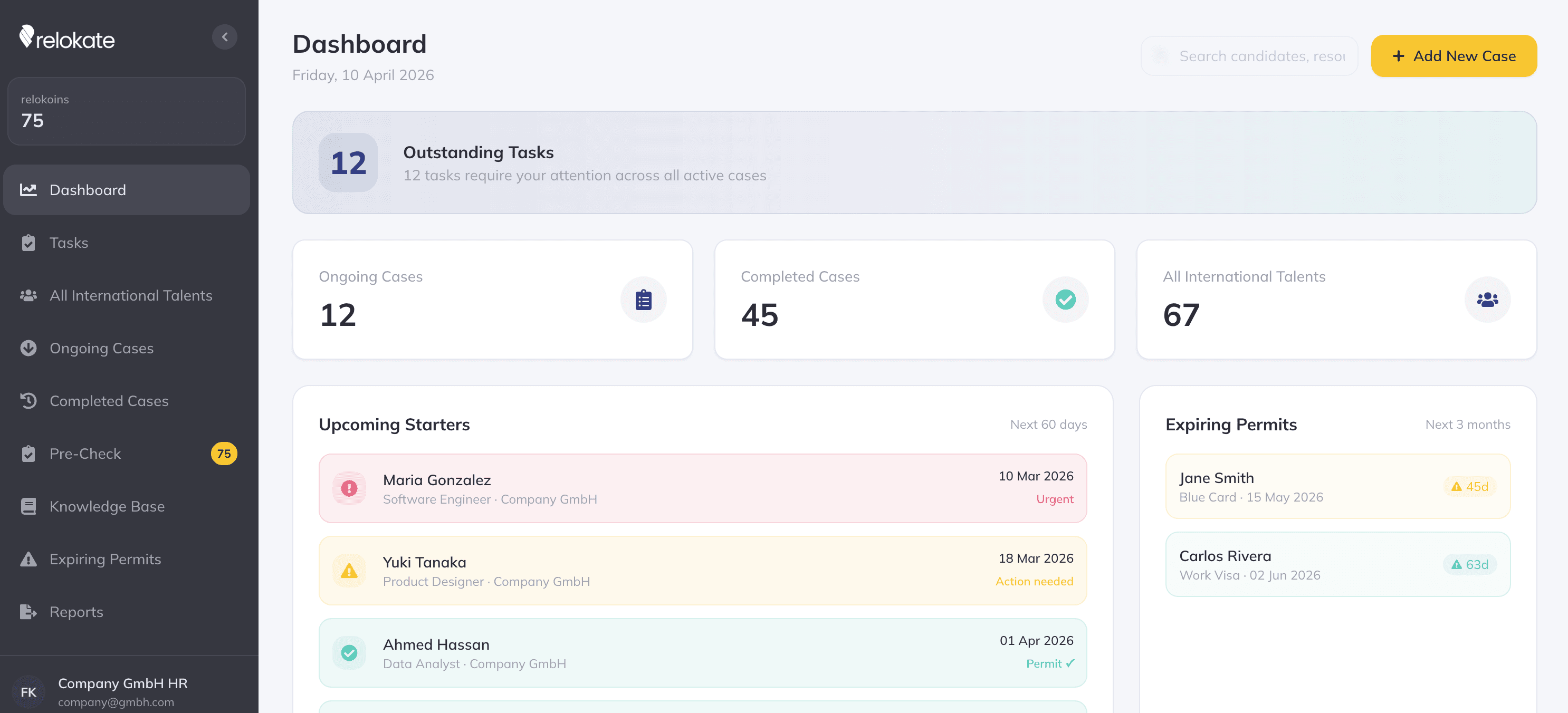
Track every case in real time — visa status, tasks, documents, and deadlines in one dashboard. Book a 15-minute call and we'll walk you through it.
Book a call →About the author

Hanna Kovacs
Product Manager, Global Mobility
Professional experience across the US, Hungary, and Germany in product management and operations. Deep expertise in German immigration law and the regulatory landscape for skilled worker migration. At relokate, Hanna owns the product roadmap, drives platform automation, and develops the compliance frameworks and immigration content that HR teams rely on.
Related glossary terms
Keep reading
Immigration & Visas
Chancenkarte Germany: How It Works & Who Qualifies
The Chancenkarte lets qualified professionals come to Germany to look for work — without a job offer. Points system, ...
Immigration & Visas
EU Blue Card Germany 2026: €50,700 Salary Threshold Explained
Does your hire qualify? €50,700 general / €45,934 shortage roles in 2026. IT without degree (3+ yrs exp). §81a fast-t...
HR Guides
Fiktionsbescheinigung: Can Your Employee Keep Working?
Whether an employee may work while their permit application is pending has to be reviewed case by case. How to avoid ...


